
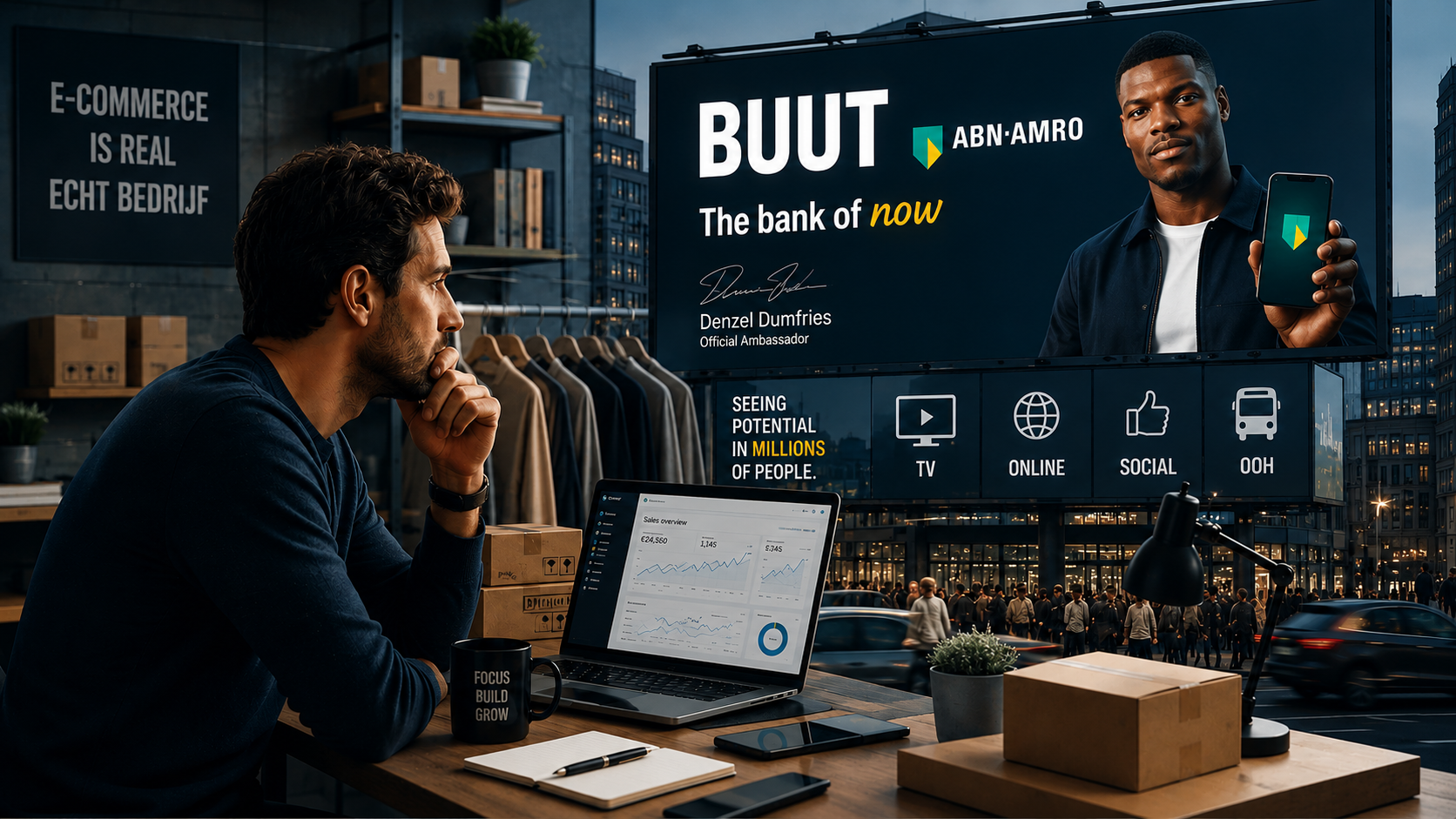
Why the BUUT Dropshipping Ad Could Harm Professional Entrepreneurs
BUUT’s nationwide campaign, created for ABN AMRO’s youth banking brand, has been highly visible since July across television, online video, social media, and cinema. With Denzel Dumfries as its ambassador, BUUT aims to encourage young people to think more critically about financial temptations and the pressure created by social media, influencers, and constantly available purchasing options. That objective is defensible in itself. Warning young people about unrealistic financial expectations and misleading income promises is useful and socially relevant.
My objection begins when a specific and legitimate business and fulfillment model is used as the negative example. The campaign states: “Everyone seems to be getting rich with dropshipping. Supposedly.” Dropshipping is therefore directly associated with the idea of getting rich quickly, after which that idea is undermined with the word “supposedly.” The resulting question is what the viewer is actually being encouraged to reject: only the unrealistic promise of wealth, or also the business model explicitly named as part of that message?
That distinction matters to anyone working professionally with e-commerce, suppliers, fulfillment, and online retail. My objection is therefore not that BUUT highlights misconduct within dropshipping. Misleading webshops, poor-quality products, concealed delivery times, and courses promising effortless wealth deserve serious criticism and, where appropriate, enforcement. My objection is that misleading behavior and an entire legitimate business and fulfillment model are not sufficiently separated in the advertising.
Dropshipping Is a Fulfillment Model, Not an Income Promise
Dropshipping essentially means that a webshop sells products without necessarily keeping those products physically in stock itself. A supplier, manufacturer, or distributor subsequently ships the product directly to the customer. That does not change the fact that the seller remains responsible for the commercial relationship with the customer, product information, pricing, delivery, complaints, returns, and compliance with consumer law.
The Netherlands Authority for Consumers and Markets also treats dropshipping as a form of online retail subject to specific consumer protection rules. Among other things, dropshippers must communicate honestly about their business, product quality, shipping origin, delivery times, prices, return options, and customer service. Dutch e-commerce industry association Thuiswinkel.org follows the same basic principle: webshops using dropshipping are subject to the same consumer rules as other online sellers.
That is fundamentally different from claiming that every dropshipping business automatically operates professionally. There are poor dropshipping webshops and good ones, just as good and bad entrepreneurship coexist within traditional e-commerce, financial services, construction, consulting, and virtually every other economic sector. The business model itself does not determine the reliability of the entrepreneur using it.
Misleading entrepreneurship should be challenged because of the misleading behavior itself. A legitimate business model should not become shorthand for those abuses.
If BUUT actually wants to warn young people against the idea that opening a webshop automatically leads to financial success, far more precise wording is available. The campaign could refer to misleading get-rich-quick claims, online income gurus, courses promising unrealistic results, or influencers who present only exceptional success stories. That would identify the actual problem without pulling an entire category of entrepreneurs into the same negative association.
Remarkably, BUUT Itself Does Make This Distinction
The contrast becomes even stronger when the advertising is compared with BUUT’s own editorial content. On its website, BUUT discusses dropshipping in a much more nuanced way. In an article about whether dropshipping provides exceptionally fast income, BUUT explains that the entrepreneur remains legally and financially responsible when things go wrong and that knowledge, customer service, and compliance with regulations are essential.
Even more relevant is a BUUT article published on May 28, 2026, about what young people can learn from dropshipping. That article explicitly distinguishes transparent selling from deliberate deception. BUUT also explains that a dropshipper carries entrepreneurial risk and that young people can learn about customers, cash flows, profit, and responsibility through online commerce.
This means that BUUT already knew before launching the nationwide campaign that dropshipping is not inherently equivalent to a simple get-rich-quick trick. Its own educational content is based precisely on the distinction between the business model itself and the way an entrepreneur uses it. Why does that exact nuance disappear when the same organization moves from an informative article to mass advertising?
Nor can television viewers reasonably be expected to visit BUUT.com after seeing the commercial and read a separate background article in order to discover the missing nuance. The commercial must stand on its own. Explanatory website content cannot retrospectively neutralize the possible meaning of a frequently repeated television advertisement.
Intention and Actual Effect Are Different Things
ABN AMRO has now reconsidered my complaint. Its Legal department acknowledges that my objection does not primarily concern what BUUT says it intends to achieve, but rather the possible effect of the wording on recipients. ABN AMRO then argues that most viewers would reasonably interpret the message as criticism of exaggerated success stories and not as a judgment on dropshipping as a business model.
That response raises additional questions. If an organization claims that most viewers interpret a message in a particular way, it is reasonable to expect a factual basis for that conclusion. In a major nationwide advertising campaign, for example, it would be possible to investigate how the target audience actually interprets the combination of the terms dropshipping, getting rich, and “supposedly.”
At least four questions are relevant to any properly substantiated assessment:
- Was it investigated beforehand how young people and other viewers interpret the specific dropshipping passage?
- Was it tested whether the negative association remains limited to get-rich-quick claims or also transfers to dropshipping webshops as a category?
- Was the potential reputational or commercial effect on entrepreneurs who use this model professionally investigated?
- Was it assessed whether the same social message could have been achieved with less generalizing wording?
These questions matter even more because the campaign does not reach only young people. A nationwide campaign across television, online video, social media, and cinema is inevitably also seen by parents, consumers, entrepreneurs, suppliers, employers, and business contacts. A message intended as financial education for young people can therefore simultaneously influence much broader public perceptions.
What Due Diligence Took Place Before the Campaign?
This leads to a more fundamental question about responsibility. A financial institution such as ABN AMRO works every day with risk assessment, compliance, reputational risk, consumer protection, and stakeholder interests. It therefore seems reasonable to expect a similarly careful prior assessment when a large-scale advertising campaign uses a specific economic activity as a negative example.
The issue is not whether ABN AMRO should have identified every individual entrepreneur in advance. That would not be realistic. The issue is whether, at category and stakeholder level, it investigated the foreseeable consequences of linking an existing business model to a questionable get-rich-quick narrative in a nationwide campaign.
Relevant questions include whether the responsible departments established beforehand what dropshipping actually involves, which professional applications exist, and which business customers or other entrepreneurs might be affected by the resulting perception. It is also reasonable to ask whether Legal, Brand, Marketing, Communications, or reputation-risk management reviewed the specific wording and which alternative formulations were considered.
The greater the reach and credibility of the sender, the more important it becomes to distinguish before publication between the conduct being criticized and the economic activity associated with that conduct.
Due diligence in this context does not mean that every advertising campaign requires a legal report running to dozens of pages. It means seriously considering the facts, potentially affected stakeholders, foreseeable consequences, and less harmful alternatives before publication. For a mass-media campaign from a major bank, that does not seem an excessive expectation.
ABN AMRO Applies a Different Level of Nuance to Its Own High-Risk Products
The discussion becomes more interesting when examining how ABN AMRO itself communicates about complex or high-risk commercial products. Through Self-Directed Investing Plus, the bank offers a range of more than 25,000 investment products, including options, complex bonds, hedge funds, warrants, and structured products. Crypto ETPs are now also available, with ABN AMRO explicitly emphasizing the risks and requiring sufficient knowledge and experience.
This comparison does not mean that these financial products are somehow “bad.” The opposite is precisely what matters. When discussing its own financial products, ABN AMRO clearly understands the difference between a product category and the risks associated with its use, unrealistic expectations, or irresponsible behavior. A high-risk product is explained, the risk is identified, and the consumer is informed.
| Aspect | Complex Financial Products at ABN AMRO | Dropshipping in the BUUT Campaign |
|---|---|---|
| Product/category identified separately | Yes | Yes |
| Risk or potential misuse explained separately | Yes | Barely in the advertisement |
| Distinction between category and irresponsible use | Clearly present | Not explicit |
| Knowledge and context provided | Yes, including knowledge requirements for certain products | Nuance is mainly provided outside the advertisement |
With crypto ETPs, for example, ABN AMRO does not say that crypto is merely a “supposed” way of getting rich because some investors enter the market with unrealistic expectations. The bank explains what the product is, warns about risks, and establishes requirements regarding knowledge and experience. That is a rational and proportionate approach.
The question is therefore not why ABN AMRO offers high-risk financial products. The question is why the bank carefully distinguishes between product, risk, and misuse when describing its own product categories, while largely abandoning that same nuance when discussing someone else’s business model in mass advertising. This is not an argument that ABN AMRO should not be allowed to criticize. It is a question about applying a consistent standard.
A Paid High-Profile Ambassador Strengthens the Message
The role of Denzel Dumfries also deserves scrutiny. BUUT deliberately positions him as an ambassador and role model. Commercially, that makes sense: a famous international footballer possesses recognition, status, and credibility that an unknown actor does not. Those qualities help a message attract attention and make it more memorable.
His role therefore cannot be reduced entirely to that of someone who happens to read a script. Dumfries participates in a commercial campaign for compensation, with his face, voice, public profile, and reputation being used to strengthen BUUT’s message. That does not automatically make him personally liable for any potential commercial damage, but it does make questions about the responsibility of a paid ambassador legitimate.
Among the relevant questions are:
- whether the ambassador reviewed and approved the specific passage in advance;
- whether he knew what the negative characterization of dropshipping was based on;
- whether he was informed that professional dropshipping is a legitimate business and fulfillment model;
- and what scope he had to discuss or reject wording in the script.
A well-known ambassador is paid precisely because personal reputation has commercial value. It would therefore be difficult to argue that the reputation is fully relevant when persuading the public but becomes entirely irrelevant once questions arise about the content being distributed with the help of that reputation.
Small Businesses Cannot Easily Correct Nationwide Framing
A second fundamental issue is the imbalance in communications power. An individual e-commerce entrepreneur does not possess the budget of a major financial institution to run nationwide television, online video, social media, and cinema campaigns. When an association around dropshipping is created on that scale, smaller businesses cannot simply deploy an equivalent counter-message.
Professional entrepreneurs can of course communicate transparently with their own customers. They can explain where products come from, which supplier handles delivery, how long shipping takes, and how returns are managed. They can invest in customer service, content, branding, and a professional website. But that is fundamentally different from having the ability to correct nationwide perceptions surrounding an entire business model.
That difference in reach makes careful communication more important. A major sender not only has greater financial resources but often enjoys more institutional trust as well. When a bank in particular associates a business model with questionable get-rich-quick thinking, that message may carry more weight for some recipients than the same statement made by an arbitrary social-media user.
For Me, This Directly Affects Entrepreneurship
For me, this discussion is not theoretical. I have spent approximately fifteen months preparing and commercially developing e-commerce and dropshipping initiatives. That work includes not only websites and products, but also supplier selection, product ranges, pricing, processes, content, marketing, customer service, positioning, and the development of business relationships.
Relationship management and networking are particularly important during the start-up phase. New initiatives need to be explained to suppliers, potential partners, and other business contacts before a company has enough history to rely entirely on demonstrated results. When a famous professional athlete and a nationwide campaign simultaneously distribute a negative association around the same business model, that can potentially affect the context in which those commercial conversations take place.
There is also the fact that ABN AMRO is my own primary bank. I am not suggesting that a bank must know or support every activity of every individual customer in advance. I do, however, consider it reasonable to expect a major business bank to understand that some of its customers are e-commerce businesses and webshops that use direct supplier fulfillment in whole or in part. Whether those business interests were considered before launching the campaign is therefore relevant.
Criticism of Misconduct Is Essential
A critical discussion about dropshipping is necessary. Consumers should be able to trust that webshops communicate honestly and comply with their legal obligations. Entrepreneurs who deliberately deceive consumers or leave them dealing with avoidable problems should not be shielded by a debate about terminology.
The same applies to influencers, coaches, and course sellers who tell young people that a webshop and a handful of advertisements are enough to achieve rapid financial independence. Building a professional e-commerce business requires knowledge, investment, supplier management, marketing, technology, processes, and above all a great deal of work. Anyone claiming otherwise presents an unrealistic picture of entrepreneurship.
That is precisely why the debate does not need to be oversimplified. We can simultaneously acknowledge serious abuses and demand that professional entrepreneurs are not automatically equated with those abuses. Those positions are not contradictory. They reinforce one another, because effective regulation depends on clearly identifying the conduct that is actually problematic.
I Am Looking for Support for the Distinction, Not a Free Pass
With this article, I am not trying to assemble a group that claims everything falling under dropshipping is automatically legitimate. Such a position would be just as simplistic as the problem I am criticizing. I am looking for entrepreneurs and experts who believe professional e-commerce should be assessed on transparency, customer treatment, product quality, regulatory compliance, and actual business conduct.
I would therefore like to hear from webshop owners, suppliers, distributors, e-commerce professionals, marketers, lawyers, and industry organizations with experience of this form of fulfillment or the public perceptions surrounding it. People who are highly critical of dropshipping are equally welcome in that discussion, provided the distinction between the business model and specific misconduct is taken seriously.
The central issue ultimately extends beyond this one BUUT campaign. How carefully should an organization with substantial social influence and media reach handle the public framing of entire economic categories? And what responsibility arises when an organization could easily have chosen a more precise target, yet nevertheless uses a broad business model to make its message more recognizable and powerful?
For BUUT and ABN AMRO, there remains a straightforward alternative. Continue warning young people about misleading get-rich-quick promises. Identify poor business practices and harmful conduct. Explain why entrepreneurship requires knowledge, responsibility, and effort. But explicitly preserve the distinction that BUUT already demonstrates it understands in its own educational content.
Combating deception and protecting professional entrepreneurs against unnecessary generalization can be done at the same time. Anyone who believes that distinction matters is invited to speak up and share their experience.
Related Articles on Professional Dropshipping:
WHY PROFESSIONAL DROPSHIPPING
SHOULD NOT BE CONFUSED WITH
MISLEADING GET-RICH-QUICK CLAIMS

READ WHY PROFESSIONAL E-COMMERCE REQUIRES RELIABLE SUPPLIERS, TRANSPARENT CUSTOMER SERVICE AND RESPONSIBLE FULFILLMENT — AND SHOULD NOT BE EQUATED WITH MISLEADING GET-RICH-QUICK PROMISES.
WHY CURRENT PRODUCT DATA MAKES PROFESSIONAL DROPSHIPPING SCALABLE
AND RELIABLE

READ HOW API CONNECTIONS KEEP PRODUCT INFORMATION, PRICES AND INVENTORY CURRENT WHILE REDUCING MANUAL ERRORS AND CREATING THE DATA FOUNDATION FOR SCALABLE, RELIABLE E-COMMERCE OPERATIONS.
WHY RELIABLE ORDER AND RETURN
FLOWS ARE ESSENTIAL FOR
PROFESSIONAL DROPSHIPPING OPERATIONS

READ HOW ORDERS, TRACKING, CUSTOMER NOTIFICATIONS, PAYMENTS AND RETURNS COME TOGETHER IN ONE CONTROLLED FLOW THAT IMPROVES CUSTOMER SERVICE AND SUPPORTS RELIABLE PROFESSIONAL DROPSHIPPING.
OnlineMarketingMan
Build. Automate. Expand.