
Why Dynamic Pricing Pays Off Now
In many ecommerce businesses, the selling price still comes from a relatively simple calculation: purchase cost plus a target markup. That price often remains unchanged until a campaign, seasonal shift, or inventory problem forces a manual correction. The market does not operate on that schedule. Demand, advertising costs, competitive pressure, available inventory, and return exposure change continuously, which means the same price can be profitable at one point and quietly erode value only a few weeks later.
That erosion can remain hidden for a long time because it rarely stems from one major pricing mistake. It develops through small deviations accumulated across thousands of transactions, multiple channels, and many product variants. A price that is too low during scarcity reduces revenue per order, while a price that remains too high as demand softens puts conversion and advertising efficiency under pressure. At the same time, slow-moving inventory can continue tying up capital at an unchanged price even when a controlled markdown would produce a better financial outcome.
Dynamic pricing is therefore not a mechanism for continuously undercutting competitors. In a mature implementation, it is a governed decision layer that allows prices to respond to demand, inventory, channel costs, and commercial priorities within predefined margin boundaries. The objective is not maximum price movement but better decision-making: every adjustment must be explainable, remain inside financial guardrails, and demonstrably improve net margin, inventory velocity, or strategic positioning. Price then stops being a stand-alone label and becomes an integrated component of the commercial operating model.
Static Prices Create a Structural Margin Leak
Fixed prices are often associated with stability, but that stability is largely administrative. When demand rises and inventory becomes scarce, price frequently remains unchanged even though the market could support greater revenue per order. The missed amount may appear small on an individual transaction, but it becomes material when the same deviation persists for weeks on a high-volume product. The business may report revenue growth while failing to capture the margin that its current demand and inventory position could have supported.
When demand declines, the opposite effect occurs. A price that was previously competitive can become relatively expensive as competitors adjust, delivery times change, or the product loses visibility. The result is a lower click-through rate, more expensive customer acquisition, and weaker conversion. Marketing may respond by adding media spend or promotions while the underlying price position remains unexamined. The company then pays more for traffic that produces less value and optimizes visible symptoms instead of addressing the economic cause.
Inventory amplifies both effects. Fast-moving products sometimes remain unnecessarily inexpensive because scarcity is absent from the pricing logic; slow-moving products stay too expensive, keeping capital tied up and increasing markdown exposure. This creates tension among marketing, procurement, logistics, and finance. Each function sees a different part of the problem, but no team can resolve it independently as long as pricing, inventory, and channel costs are managed with different definitions and reporting logic.
The relevant management question is therefore not how often prices change, but how much economic deviation a static price creates without being noticed. Answering that question requires comparing realized net margin, inventory turnover, acquisition costs, and conversion across different pricing and demand conditions. Only when those relationships are visible can management determine which categories genuinely benefit from dynamic price controls and where a fixed price remains the better decision because of brand, contractual, or customer-experience considerations.
Price controls more than revenue per order; it also shapes demand, visibility, and capital utilization.
Rules Before Algorithms: Design the Decision Space First
A mature dynamic pricing model begins not with software or an algorithm, but with explicit commercial guardrails. Without clear limits, automation quickly becomes price volatility: the system responds to every temporary change even though no one has determined which business objective should take precedence. A lower price may stimulate volume while destroying net margin; a higher price may increase revenue per order while harming visibility or customer trust. The organization must therefore define in advance which tradeoffs the model may make and which risks it may never take autonomously.
The decision space requires, at minimum, a financial floor, a commercial ceiling, an approved change frequency, and explicit exception rules. The financial floor must reflect actual net contribution rather than simply selling price minus product cost. The ceiling must account for brand positioning, relative competitive value, and potential reputational damage. Frequency limits prevent short-term noise from producing restless price movements, while exception rules protect product launches, contracted prices, campaign commitments, and products governed by a published or manufacturer-controlled price. The initial design must also define the minimum contribution retained by SKU, channel, or order, the range within which the model may operate autonomously, the signals that can activate a change, and the cases that always require human approval.
These controls do not make dynamic pricing slower; they make it usable. They ensure that each price movement remains rational, explainable, and auditable after the fact. During the first phase, dynamic pricing should not attempt to maximize profit on every individual order. The model must first prove that it can make reliable decisions within controlled boundaries, handle exceptions correctly, and produce measurable effects on margin, volume, and customer behavior without destabilizing the assortment.
The Data Layer Determines Whether Pricing Can Be Trusted
Dynamic pricing can operate responsibly only when its inputs are current, consistent, and comparable. Many organizations have enough data but distribute it across the ERP, ecommerce platform, advertising systems, marketplace accounts, and return reports. Revenue is measured at one level, inventory at another, and channel costs may not be calculated until after the period closes. An algorithm cannot repair that fragmentation by itself; it will simply convert incomplete definitions into pricing decisions more quickly. The following components together form the minimum data layer required for a governed pricing model:
| Data Component | Strategic Significance |
|---|---|
| Current product cost | Establishes the financial floor and absorbs cost changes |
| Channel cost per order | Translates gross margin into net contribution by sales channel |
| Return impact by SKU | Prevents overstated profit on return-sensitive products |
| Inventory and days on hand | Connects price with velocity, scarcity, and capital utilization |
| Conversion by price point | Makes elasticity and volume response measurable |
| Competitor price and delivery time | Defines relative market position and commercial flexibility |
Value emerges only when these data points share the same level of granularity and time dimension. A current SKU-level price cannot be evaluated reliably against weekly average inventory at the parent-product level or channel costs available only as a monthly aggregate. The model must know which price was active, how much inventory was actually sellable, which advertising cost preceded the order, and which return cost appeared later. Without that timeline, correlation can easily be mistaken for causation, and a price change may receive credit for an outcome that was actually driven by a campaign, seasonality, or product availability.
Data quality therefore requires ownership and controls before pricing automation is scaled. SKU mapping, cost allocation, inventory status, and return definitions must align across systems. Exceptions should not be logged only as technical errors; they should also be weighted by financial exposure. A missing product cost on a high-volume SKU requires a different priority than the same defect on an item with no current sales. The data layer then becomes more than a passive reporting foundation: it becomes a governed service on which pricing decisions can demonstrably rely.
From Pilot to a Controlled Learning Process
Dynamic pricing does not need to be deployed across the entire assortment immediately. A strong pilot begins in a category with enough SKUs, consistent transaction data, and sufficient flexibility to permit limited price movement. Products governed by contractual agreements, high reputational sensitivity, or exceptionally low volume are less suitable for the first phase. The pilot should not be judged by a dramatic revenue spike, but by whether price adjustments create repeatable value while remaining within the agreed financial and commercial boundaries.
A baseline, test groups, and evaluation windows must be established before the pilot starts. The baseline should cover net contribution, conversion, velocity, advertising expense, and return impact before intervention. A control group shows which portion of the change would have occurred without the new pricing logic. Evaluation windows prevent decisions after a single day when weekly patterns, campaigns, or inventory changes may distort the result. Logging must record which rule caused an adjustment, which data was available, and whether the outcome remained inside the expected range. Expansion should occur only when four forms of evidence are available at the same time:
- net contribution improves without unacceptable loss of conversion or volume;
- inventory velocity and availability respond as projected in the business case;
- price movements remain within brand, channel, and competitive guardrails;
- exceptions can be detected in time and reversed without loss of data.
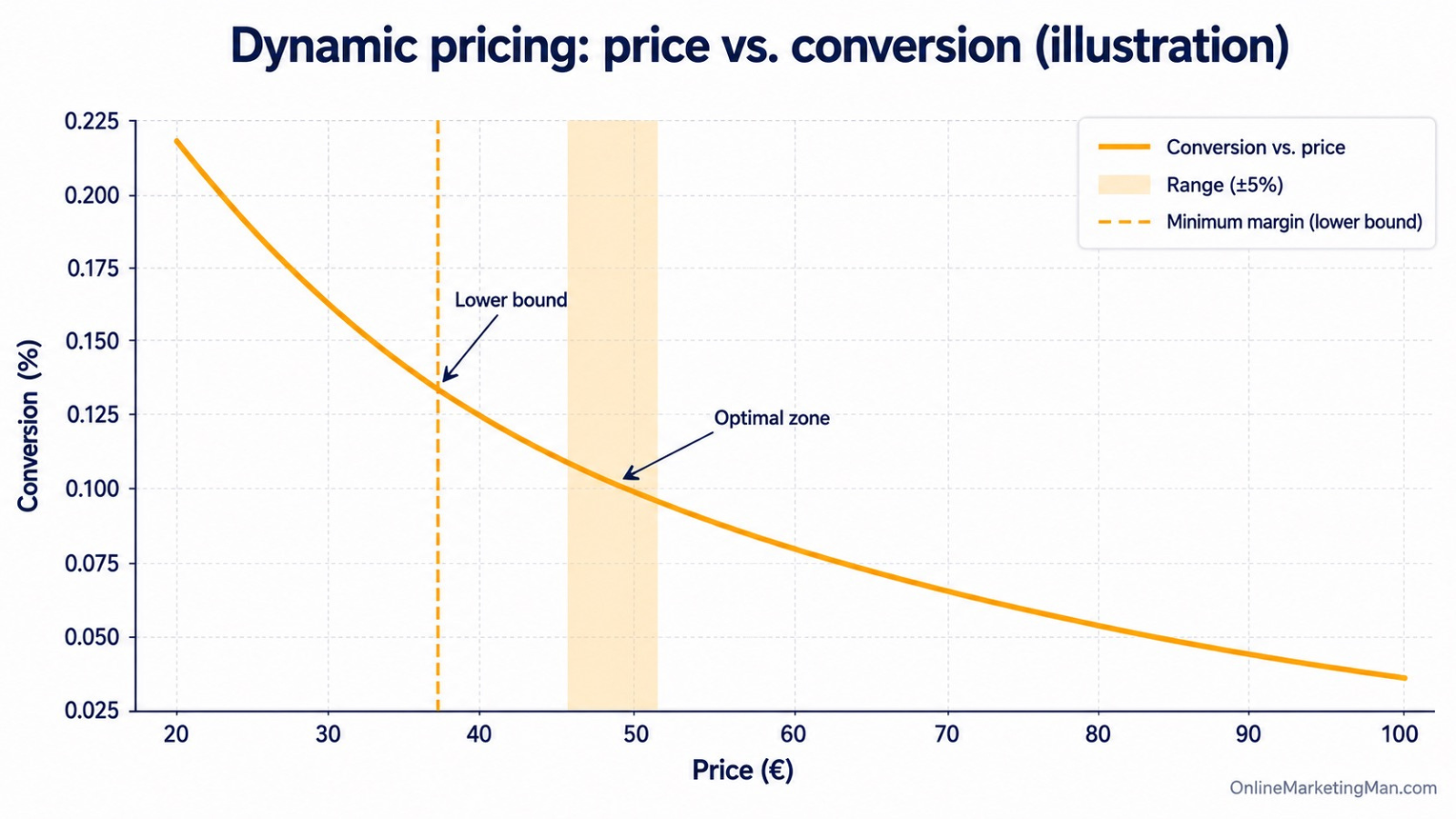
Price elasticity does not require a complex predictive model during this phase. Small, controlled price steps already reveal whether a product is relatively insensitive, moderately sensitive, or highly price sensitive. If a modest increase does not create a meaningful decline in conversion, the company can improve margin without significant volume loss. If a small reduction produces a measurable increase in demand and net contribution, price may be an effective activation lever. The assessment must remain focused on the total economic result rather than revenue or conversion in isolation.
Variant-level analysis is essential. The popular size, color, or configuration often determines conversion for the entire parent product, while availability and price pressure vary significantly among variants. A uniform price adjustment can unnecessarily discount a strong variant or fail to correct a weak one. Treating variants as independent commercial units within one governed product structure creates a more accurate relationship among demand, price, availability, and margin. Advertising controls and replenishment priorities can then support the variants that are both sellable and economically attractive.
Net Contribution by SKU as the Core Control Variable
Many organizations still manage pricing through gross margin even though it provides only a partial view of actual profitability. Selling price minus product cost is a useful starting point, but it ignores expenses that are directly tied to the channel, order, and product behavior. Advertising spend, marketplace commissions, payment fees, fulfillment, customer service, and returns can sharply reduce an apparently healthy margin. If the pricing model excludes those costs, it can increase volume successfully while simultaneously weakening operating profit.
Consider a product with a selling price of $100 and a product cost of $55. The administrative view suggests that $45 of margin is available. After $14 in acquisition expense, $8 in fulfillment and payment costs, $5 in expected return impact, and $3 in channel-related service costs, only $15 in net contribution remains. A $4 price reduction represents just four percent of the selling price, but in this example it reduces net contribution by more than one-quarter. Conversely, an increase of only a few dollars can improve profitability disproportionately when conversion remains largely unchanged.
Net contribution by SKU and channel therefore becomes the shared control variable for marketing, finance, procurement, and logistics. Marketing sees not only how much revenue a campaign generates, but what remains after acquisition and returns. Procurement can connect terms and purchasing volume to the actual return of product flows. Logistics gains visibility into the financial value of velocity and inventory age, while finance can determine whether growth is adding structural value. The debate over local success metrics does not disappear completely, but it is anchored in one economic definition.
This approach also prevents pricing decisions from becoming disconnected from capital utilization. A product with limited margin may still be strategically attractive if it turns quickly, drives repeat purchases, or attracts valuable customers. A product with high gross margin can be unfavorable if it sits in inventory, generates excessive returns, and requires expensive traffic. A mature model therefore evaluates price in relation to contribution, velocity, inventory value, and customer value. Only at that level can the organization determine which price movement genuinely strengthens the business.
Governance, Monitoring, and Internal Alignment
As pricing decisions become more dynamic, the primary challenge shifts from implementation to control. Marketing may want to use price to stimulate growth and visibility, while finance protects margin, procurement focuses on commercial terms, and logistics optimizes velocity and availability. Without shared definitions and authorities, teams make corrections that are rational locally but conflict at the enterprise level. Dynamic pricing then becomes not an integrating control layer, but an accelerator of existing organizational friction.
Governance defines who owns data quality, decision rules, exceptions, and model performance. Monitoring then reveals whether the system operates within those boundaries and what effects it produces. The two functions must work together: governance without monitoring is policy without factual control, while monitoring without governance generates signals without determining who must act. A mature operating model therefore includes at least:
- one accountable owner for pricing logic, margin definitions, and exception policy;
- a change process with version control, logging, approval, and rollback;
- alerts for margin breaches, abnormal conversion, and excessive change frequency;
- a recurring review that evaluates financial, commercial, and operational effects together.
Monitoring must go beyond average price or total revenue. Relevant indicators include net contribution by SKU and channel, price changes per period, conversion before and after an adjustment, exception rates, days on hand, and the time required to resolve deviations. Distribution matters as well: a positive average can conceal major improvement among a few top sellers while most of the assortment deteriorates. Dashboards should therefore make portfolio-level performance visible without hiding the underlying segments and variants.
The combination of governance and monitoring creates a feedback loop through which the organization can demonstrate that it is learning. Rules that repeatedly fail to add value can be refined or removed, while successful patterns can be extended to other categories under controlled conditions. Exceptions no longer appear only as incidents, but as information about data quality, positioning, or model behavior. Changes are then repeated because of measurable effects and a documented decision history, not because of untested assumptions.
When Dynamic Pricing Does Not Pay Off
Dynamic pricing is not a universal solution. When product costs, inventory positions, or channel expenses are unreliable, pricing decisions are based on an inaccurate economic reality. Automation does not solve that problem; it distributes the error more quickly across more products and channels. In that environment, the first investment belongs in data quality, mapping, and ownership. Dynamic controls should be added only when the inputs are stable enough to explain the decisions they produce.
Brand positioning can also limit the appropriate range of movement. In markets where trust, exclusivity, or long-term price consistency matter more than short-term conversion, frequent changes may appear arbitrary or opportunistic. Customers who see a lower price shortly after purchase may request compensation or lose confidence in the brand. For those categories, the model may require longer evaluation periods, narrower bands, or recommendations that need approval from a pricing owner before publication.
A limited transaction base creates another boundary. At low volumes, it is difficult to distinguish the effect of price from seasonality, promotion, availability, and random variation. The model may overvalue apparent patterns and respond to noise. Full automation is equally unsuitable when the assortment consists mainly of unique products or when pricing is contractually negotiated by customer. Dynamic pricing pays off only when sufficient repeatable behavior, reliable data, and operational capacity exist to execute decisions consistently.
The correct conclusion may therefore be to manage only part of the assortment dynamically. A hybrid model combines fixed prices for brand-sensitive or contract-bound products with controlled movement in categories where demand, inventory, and competition demonstrably change. That selectivity is not a lack of maturity. It shows that the organization applies pricing automation where the economic evidence is strong enough and preserves stability where consistency creates greater value.
Dynamic pricing creates value only when every price movement is financially bounded, commercially explainable, and operationally executable.
Pricing as a Structural Layer of the Operating Model
When dynamic pricing is implemented maturely, the role of price changes fundamentally. Price is no longer a corrective mechanism applied after the fact, but a structural layer where demand, inventory, channel costs, and commercial priorities converge. Channels are no longer managed as isolated selling machines; they use the same margin definitions, the same product identity, and the same financial boundaries. The organization can then compare and scale pricing decisions without maintaining separate logic for every marketplace or ecommerce site.
That architecture makes performance more predictable, but not because every outcome can be known in advance. Predictability comes from controllable decision rules, input data, and exceptions. Management can explain why a price changed, which objective the adjustment served, and what impact on net contribution, volume, and inventory was expected. When the result differs, the assumption that requires revision is visible. The model builds institutional learning rather than remaining dependent on individual experience or isolated campaign decisions.
The financial value ultimately lies not in the number of price changes, but in the quality of margin and capital allocation. High-velocity products are not sold unnecessarily cheaply, slow-moving inventory does not remain blocked without reason, and media spend is not wasted on price positions that consistently fail to convert. At the same time, brand boundaries, customer trust, and operational feasibility remain protected. Growth becomes less dependent on additional volume and more dependent on how much each order actually contributes to enterprise performance.
An enterprise pricing model therefore connects four disciplines that many companies still manage separately: commercial strategy, financial control, operational availability, and data governance. Implementation begins with clear margin definitions and reliable SKU data, develops through controlled pilots, and only then expands through automation. Governance and monitoring do not end with the project; they remain permanent functions of the operating model. That combination is what prevents dynamic pricing from deteriorating into reactive volatility.
The decisive question is not whether a company can technically automate prices. It is whether the company can bound, explain, measure, and govern every price movement. When it can, dynamic pricing evolves from a tactical optimization tool into commercial infrastructure: a system that protects margin, puts capital to more productive use, and supports growth without sacrificing control. At that point, dynamic pricing does not merely pay off now; it becomes a structural component of a profitable and scalable business model.
External Link With Useful Tips:
Related Articles on Strategy, Automation and Growth:
Product Feed Data
Normalization And
Catalog Enrichment

Dynamic pricing only performs reliably when underlying product feeds are normalized and enriched. Clean product data ensures pricing logic, margin calculations, and channel distribution operate consistently across the entire ecommerce catalog.
Inventory Synchronization
Across Variants
And Sales Channels

Pricing strategies lose accuracy when inventory data is not synchronized in real time across variants and channels. Stable stock synchronization prevents pricing conflicts, overselling, and operational instability.
From Single Store
To Scalable Ecommerce
Portfolio Strategy

Automated pricing logic becomes essential when multiple stores and marketplaces operate within one growth strategy. A centralized portfolio architecture enables margin control, pricing consistency, and scalable ecommerce expansion.
OnlineMarketingMan
Build. Automate. Expand.