
Data Quality That Sells: Normalize & Enrich Product Feeds
Strong conversion begins with the quality of the information platforms and customers use to make decisions, not with additional advertising spend. Product feeds connect the assortment with Google Shopping, marketplaces, on-site search, and product detail pages. When titles are inconsistent, attributes are missing, or categories are interpreted differently across channels, friction emerges throughout the commercial value chain. Products are matched less accurately, advertising costs rise, and customers must determine whether an item actually meets their needs.
The financial consequences often remain hidden because data problems rarely appear as one identifiable failure. Instead, they surface through lower click-through rates, weaker conversion, disapprovals, support inquiries, and returns that are separately attributed to marketing, technology, or competition. Teams optimize local symptoms while the shared cause remains embedded in the product data. Higher bids, additional campaigns, and manual feed corrections may support performance temporarily, but they do not make the underlying structure more reliable.
Data quality is neither technical housekeeping nor a one-time cleanup project. It is commercial infrastructure that determines how predictably visibility, acquisition costs, conversion, and margin develop as assortment and channel complexity increase. A mature approach connects normalization, enrichment, validation, and governance within one repeatable model. The result is a controllable product information capability that enables marketing, e-commerce, and operations to work from the same commercial truth.
Why Data Quality Directly Affects Revenue and Margin
Search and shopping platforms depend on structure. Algorithms analyze product titles, attributes, categories, availability, GTIN/EAN identifiers, and technical fields to determine relevance. When this information is complete, current, and internally consistent, systems can match a product more accurately to search intent and context. That increases the likelihood of appearing for relevant queries, improves the quality of advertising traffic, and reduces clicks from users for whom the product is fundamentally unsuitable.
Incomplete or inconsistent data produces the opposite result. A product may enter an overly broad category, fall outside relevant filters, or be disapproved because required values are missing. Ads may also remain visible for searches that do not align with the product. The business pays for low-probability traffic while losing reach on more valuable queries. This lowers conversion and distorts the data used to optimize campaigns and bidding strategies.
The impact compounds because platforms use historical performance to influence future distribution. Products that repeatedly generate irrelevant impressions, few qualified clicks, or a weak click-to-purchase ratio build a different performance profile from products that are consistently understood. Data quality therefore affects more than today’s result. It also shapes how quickly an assortment can build visibility and algorithmic confidence over the months ahead.
For management, the impact becomes tangible when data quality is measured as a commercial cause-and-effect chain rather than an abstract quality score. The assessment should begin not with the number of completed fields, but with the data characteristics that demonstrably change search relevance, advertising efficiency, conversion quality, and return pressure. Four effects require separate attention because they directly influence costs, conversion, and customer value:
- Better matching to search intent improves impression quality and click-through rates.
- Fewer irrelevant clicks reduce wasted advertising spend and acquisition costs.
- Clearer product context qualifies the click more effectively and supports conversion.
- A smaller gap between customer expectations and product reality reduces support demand and returns.
These effects reinforce one another. Better matching does not merely attract more traffic; it selects traffic that fits the product more closely. A well-qualified click then increases the likelihood of purchase and reduces the risk of disappointment after delivery. The cost per profitable order declines while the platform’s historical performance data becomes stronger. The relevant return on data quality is therefore not simply greater reach, but a more efficient chain from impression to realized net margin.
Normalization: Establish One Commercial Structure Before Adding Speed
Normalization reduces product data to one consistent logic aligned with the organization’s commercial model. Suppliers frequently provide titles, colors, sizes, and technical characteristics in different formats. When those differences pass directly into distribution, each source and channel develops a different interpretation of the same product. Normalization therefore makes explicit how fields are named, which units are used, which values are permitted, and at what level products, variants, and bundles are managed.
In practice, this requires fixed title structures by category, uniform conventions for size and material, and governed value lists for color, target audience, and use case. Variations such as “Blue,” “Navy,” “BL,” and a supplier code must be translated into one meaning before publication. The same applies to centimeters and inches, units of weight, and technical specifications. This standardization prevents fragmented filters, duplicate variants, and the algorithmic treatment of comparable products as different items.
More important is one authoritative source for each data element. The organization must know where a product title is constructed, which taxonomy governs, who owns commercial attributes, and which fields are mandatory before publication. ERP, PIM, feed management, and e-commerce platforms may perform different functions, but should not maintain separate versions of the same truth. Without clear responsibilities, corrections are applied in multiple places and discrepancies return with the next supplier or channel export.
Treating data quality as an IT cleanup temporarily reduces correction costs. Governing it as commercial infrastructure protects revenue, margin, and scalability over time.
Normalization also increases speed only when it is connected to validation. Before publication, rules must verify that identifiers are unique, mandatory attributes are present, values fall within accepted ranges, and variant relationships remain intact. Exceptions are not silently ignored or manually repaired in an export file; they are routed back to the source and assigned to an owner. Speed then no longer means distributing errors faster. It means delivering correct product data to every channel quickly and repeatably.
Enrichment: Move From Technically Valid to Commercially Persuasive
A normalized feed can be technically correct and still lack commercial substance. Standard fields make a product discoverable, but do not answer every question that drives a purchase decision. Enrichment adds context for matching and evaluation: material, compatibility, audience, use case, differentiating characteristics, and the conditions under which the product is the strongest choice. Valuable attributes differ by category and should be derived from search behavior, customer questions, return reasons, and commercial positioning.
The quality of enrichment is determined not by the number of populated fields, but by their informational value. An attribute that supports neither search intent, filter selection, nor decision-risk reduction mainly adds administrative burden. An attribute that distinguishes a relevant product variant or prevents a common mismatch can directly affect conversion and returns. A mature data model therefore prioritizes attributes according to commercial impact and defines which information is essential, supporting, or optional for each category.
Enrichment should be treated as a continuous learning process. New search terms reveal customer language. Return reasons show where expectations are not met, and service questions identify information missing before purchase. When these signals are translated into titles, attributes, and content fields, the feed evolves with the market. Product information remains complete according to technical standards and relevant to changing behavior and new commercial applications.
Continuous enrichment also strengthens performance stability over time. Products with clear and consistent attributes build historical data that platforms can interpret more reliably. Search positions are then supported not only by temporary bid pressure, but by a growing relationship among product context, search intent, and realized behavior. The business becomes less dependent on recurring campaign corrections and develops a product information layer that gradually increases its own commercial evidence.
Matching Before the Click Determines Quality After the Click
A normalized and enriched feed produces two mutually reinforcing effects. First, algorithmic matching improves, so products appear more often in relevant search results and filters. Second, the click itself becomes better qualified because the user receives more context about characteristics, suitability, and limitations before visiting the product page. The first effect increases relevant visibility. The second determines how much of that visibility can develop into a purchase with a healthy commercial outcome.
Qualification before the click matters because conversion is not determined solely by persuasion on the product page. When an ad, filtered result, and product detail page create different expectations, the customer journey begins with an information break. The user must reassess the product and may abandon the journey or be disappointed after purchase. Consistent product context reduces uncertainty, shortens evaluation, and avoids spending on traffic that better information could have excluded earlier.
When matching and qualification improve together, the meaning of growth changes. More clicks are no longer the primary success criterion. What matters is how many clicks become profitable orders with limited return and support costs. Management therefore moves from superficial reach metrics toward commercial evidence. Product data determines not only where an item appears, but also the expectation with which a prospective customer takes the next step.
Data quality determines not only whether a product is found, but whether the click has been qualified well enough to become a profitable order.
Example: From a Generic Feed Record to a Governed Product Variant
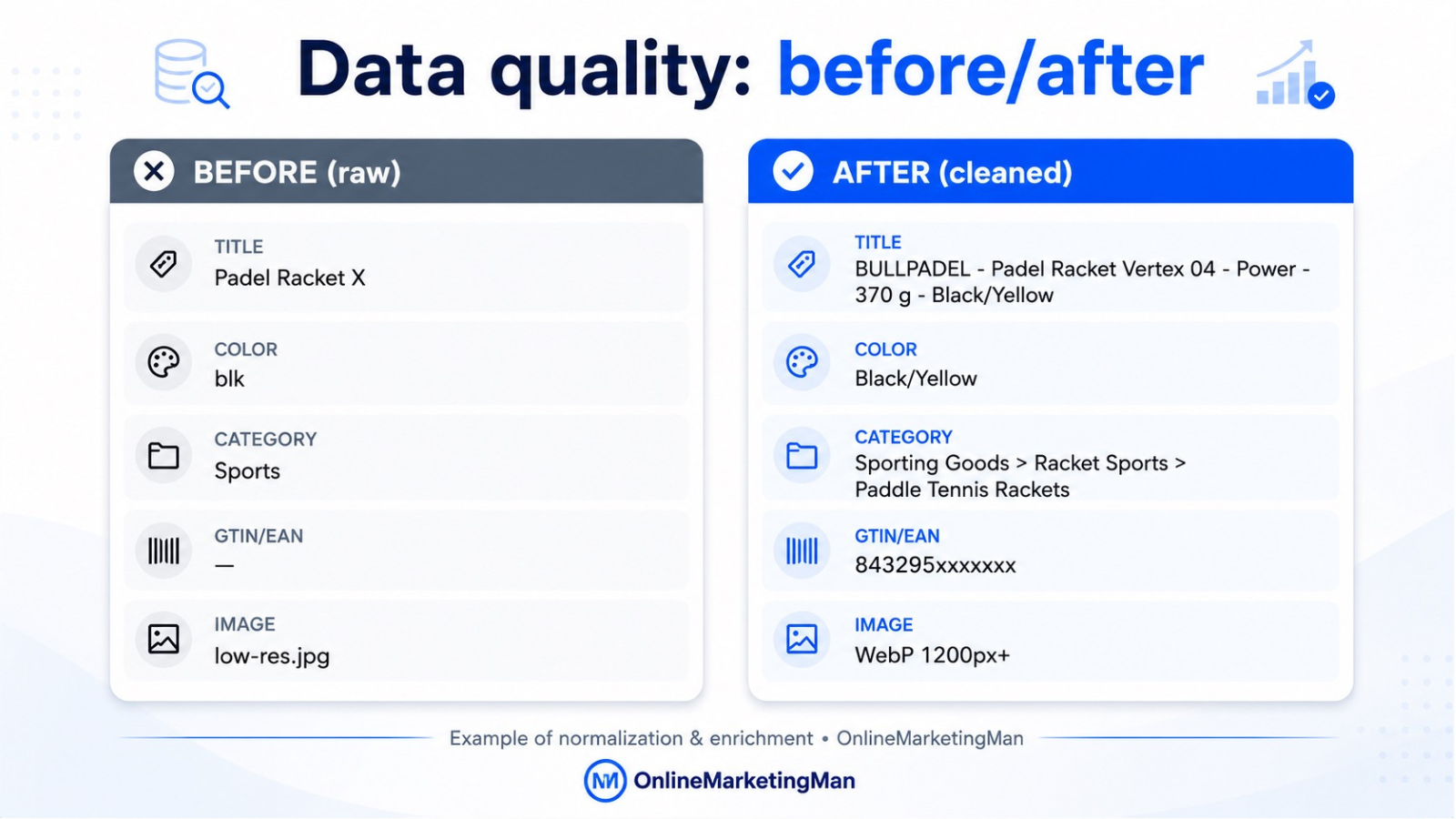
Consider a padel racket whose source record contains only a brand, model, price, and generic description. Essential characteristics such as weight, balance, material, playing style, and skill level are missing or buried in unstructured text. The product can be published, but platforms cannot filter it effectively or match it reliably to specific intent. A beginner, a defensive player, and a customer seeking a lightweight racket may receive the same result, although the feed does not explain who the product serves.
After normalization, brand, model, year, weight class, balance, material, and variant relationship are recorded in one data model. Enrichment then adds commercial context such as comfort level, intended playing style, and compatible use case. The title does not need to contain every value, but each channel can construct it from controlled components. Filters work more consistently, searches are matched more specifically, and individual versions remain recognizable as variants of the same parent product.
The improvement extends beyond presentation. It allows performance to be analyzed at variant level and differences to be related to inventory, price, and audience. If one weight class attracts many clicks but few purchases, the business can investigate whether context, availability, or positioning is inadequate. Without normalized variant data, the pattern remains hidden in a product-level average, and budget or pricing decisions are made from an incomplete view.
This example demonstrates why data quality must be connected directly to decision-making. A better feed does more than produce cleaner fields; it makes commercial causes traceable. Marketing can target with greater precision, e-commerce can improve product context, purchasing can assess demand at variant level, and operations can publish availability more consistently. The product feed becomes a shared decision layer instead of a technical export file that receives attention only when a channel reports errors.
Move From One-Time Cleanup to Structural Data Governance
Many organizations begin with a one-time cleanup. The feed looks better temporarily and disapproval rates decline, but inconsistencies eventually return. Values may have been corrected, while source processes, ownership, and publication rules remain unchanged. New products are entered according to old practices, supplier updates overwrite enrichment, and channel-specific workarounds create new versions of the same truth.
Structural improvement requires a fixed sequence of audit, design, validation, publication, and monitoring. The audit identifies commercially critical fields and the points where discrepancies originate. A target model is then established for each category, including taxonomy, required attributes, value lists, and ownership. Validation prevents incomplete or conflicting records from going live, while phased publication and rollback capabilities keep the operational impact of changes under control.
Governance converts this process into management agreements. Marketing is not automatically the owner of every commercial characteristic, and IT should not decide which context is relevant to a purchase decision. E-commerce, merchandising, operations, and data functions must jointly define who manages definitions, who approves exceptions, and how quickly errors must be resolved. Data quality then becomes an explicit responsibility with measurable service levels rather than an issue that continues to circulate among teams.
A central data logic also makes scalability controllable. New markets, channels, and product lines can reuse the same core structure while language, local taxonomy, and channel requirements are added as governed variants. The organization no longer needs to redefine how product data is built for every expansion. It extends an existing operating model and prevents commercial growth from creating complexity faster than operations can manage it.
KPIs That Connect Data Quality to Financial Outcomes
A mature measurement model goes beyond the percentage of completed fields. Data completeness is necessary, but it does not show whether values are accurate, relevant, or commercially useful. Product data performance should therefore be tracked from source quality through platform acceptance, click behavior, conversion, and return impact. Only then can management determine which improvements create value and which changes mainly add administrative perfection.
The following framework connects operational quality indicators to their strategic meaning. These KPIs should not be managed as isolated dashboards; they must be interpreted together. A higher click-through rate is positive only when click-to-purchase performance and net contribution remain stable or improve at the same time. A lower disapproval rate creates commercial value only when relevant visibility and revenue continuity actually increase.
Core KPIs for Commercial Product Data Quality
| KPI | What It Measures | Strategic Significance |
|---|---|---|
| Data completeness and validation rate | Presence, validity, and consistency of critical fields | Predictable publication and scalability |
| Disapproval and warning rate | Feed compliance and platform eligibility | Continuity of paid and organic visibility |
| CTR by category and attribute coverage | Quality of matching and the pre-click proposition | More efficient reach and less waste |
| Click-to-purchase rate | Alignment among the feed promise, product page, and customer need | Higher conversion and greater productivity from media spend |
| Return and support impact | Gap between created expectations and product reality | Stronger net margin and customer experience |
Analysis must be available at category, product, and variant level. A positive portfolio average can conceal significant improvement among a few high-volume items while other segments continue to underperform structurally. Connecting data quality to performance segments reveals which attributes actually make a difference and where additional enrichment produces no demonstrable return. Prioritization can then be based on financial impact instead of how easily a field can be completed.
The time dimension is equally important. An improvement in product data does not always produce an immediate effect because platforms must reprocess new information and historical signals change gradually. Evaluation windows should therefore account for indexing, campaign cycles, seasonality, and inventory availability. Without that context, a relevant structural improvement may be rejected too early, or a simultaneous campaign may receive undue credit for the entire result.
Common Failure Patterns and Their Governance Causes
Recurring feed problems rarely persist because teams do not know how to change a field technically. They remain because temporary workarounds appear less expensive than modifying source logic, ownership is unclear, or channel results are optimized separately. The same product then receives a different title in each export, internal categories are distributed without mapping, and image or attribute quality is reviewed only after performance has already declined.
A structural solution begins by identifying where a discrepancy originates, who owns the source definition, and why a channel correction does not flow back into the central data model. Four patterns deserve particular attention. They may look different operationally, but they repeatedly produce the same governance outcome: multiple versions of the truth, inconsistent channel interpretations, and commercial performance that cannot be reliably traced to its cause:
- Generic title templates ignore category differences and weaken relevant product context.
- Cleanup at the export level leaves errors in the ERP, PIM, or supplier mapping unresolved.
- Internal categories are connected to platform taxonomies without governed translation.
- Attribute, identifier, and image quality receive no financially weighted priority.
These patterns have a cumulative effect. A generic title may reduce relevance, a missing attribute restricts filters, and a weak image then reduces persuasive power. Each discrepancy appears manageable on its own; together they affect visibility, conversion, returns, and the product’s historical quality signals. Structural correction therefore requires more than four isolated repairs. It requires one source model in which rules, exceptions, and responsibilities demonstrably align.
The governance test is whether a discrepancy can recur after remediation. If an employee must manually correct the same error during the next import, the problem has not been solved; it has been temporarily concealed. Enterprise-grade feed management records the cause, changes source logic or validation, and verifies that every relevant channel processes the correction consistently. This reduces error frequency and shortens the time between detection and sustainable resolution.
Data Quality as Governed Commercial Infrastructure
Data quality ultimately determines not only how products appear, but how consistently they are interpreted across different ecosystems. When titles, attributes, categories, identifiers, images, and availability are published from one governed structure, visibility, relevance, and conversion reinforce one another. Traffic quality improves because platforms select more accurately and customers understand before the click what they can expect. Less corrective spending is then required to achieve the same or stronger commercial results.
The strategic advantage comes from the interaction among all model layers. A complete title cannot compensate for a missing variant relationship, and a strong image does not resolve an incorrect category. Each layer influences product interpretation and the decisions made by algorithms and people. Managed separately, these layers leave performance vulnerable to inconsistency. Operating through shared definitions and governance, they create an advantage that additional media spend cannot easily replicate.
For management, product data must become part of the commercial operating model. Investments should be assessed not only by lower correction costs, but by their effect on acquisition efficiency, revenue continuity, return pressure, speed to market, and net margin. Ownership must be distributed across the functions that create source data, define commercial meaning, and control publication. Dashboards connect data quality to results so priorities can be ranked by value.
This structure makes scale more controllable. New products and channels can be added without rebuilding the data foundation each time because the core structure, validation rules, and responsibilities already exist. Local requirements are introduced as governed variants instead of isolated workarounds. Discrepancies can also be traced more quickly to a source, rule, or channel, allowing growth without a proportional increase in manual correction and operational uncertainty.
The decisive question is not whether a product feed can be published, but whether the organization can explain why every product is found, understood, and purchased correctly. When it governs definitions, constrains exceptions, measures quality financially, and anchors improvements at the source, product data moves from supporting administration to commercial infrastructure. At that level, data quality does more than support conversion: it determines how sustainable, scalable, and profitable e-commerce growth can be governed.
Related Articles on Strategy, Automation and Growth:
Feed Distribution
And Channel Mapping
Across Marketplaces

Without normalized product data, channel distribution quickly becomes inconsistent across marketplaces and platforms. Structured catalog feeds ensure every channel receives accurate, commercially usable product information.
Variant-Level SEO
Structured Data And
Search Visibility

Search visibility at variant level requires structured and enriched product data that is consistently delivered to both search engines and marketplaces through standardized feed architecture.
API-First Dropshipping
From Product Feed
To Automated Revenue

High-quality product data forms the foundation of API-driven automation, where product information flows reliably into order processing, inventory synchronization, and pricing systems without manual intervention.
OnlineMarketingMan
Build. Automate. Expand.