
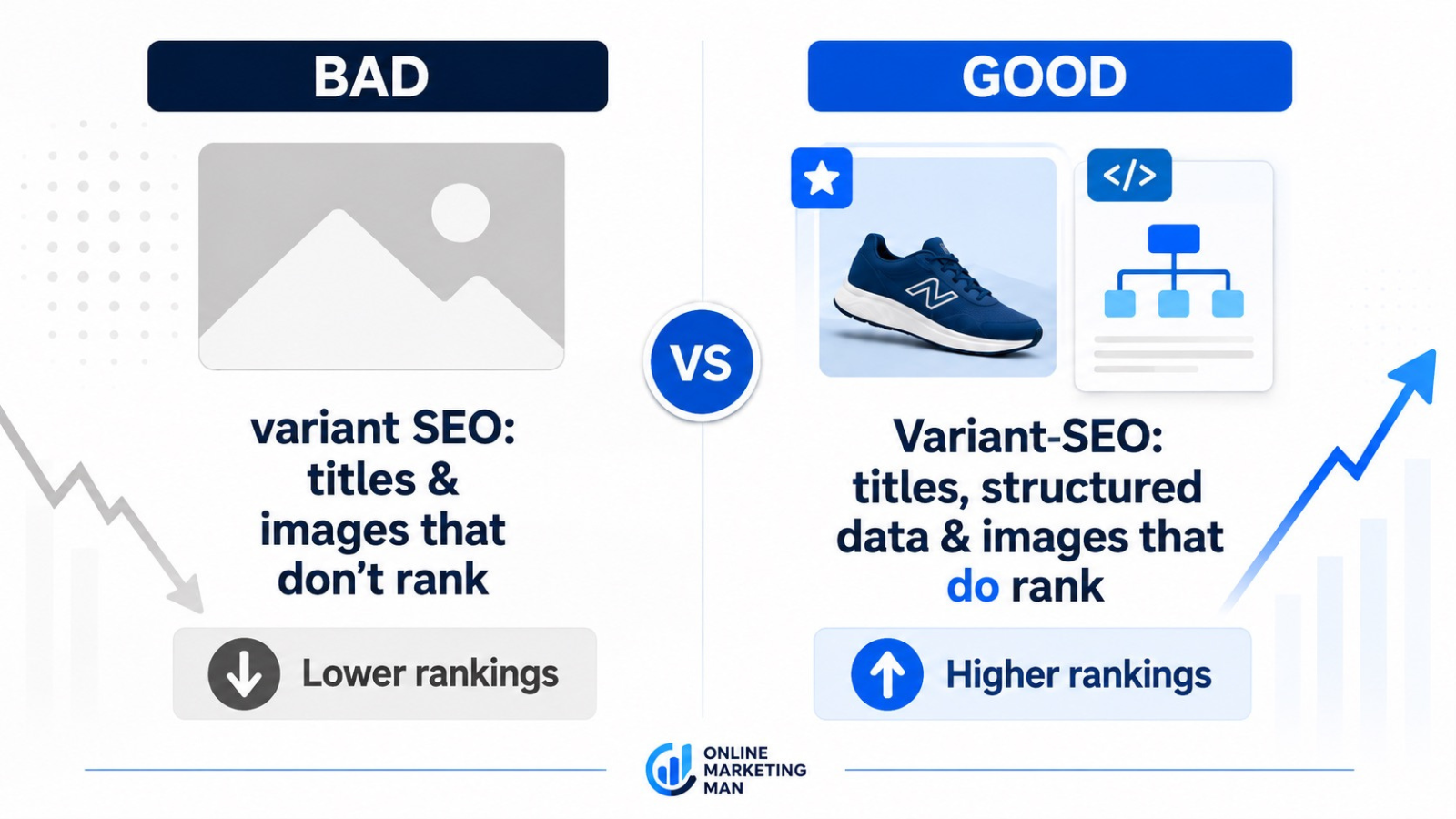
Variant SEO: Titles, Structured Data, and Images That Actually Rank
In many e-commerce environments, variant management is still treated as a technical layer required for product configuration rather than as a strategic mechanism for visibility and conversion. That approach appears logical from a systems-architecture perspective, but in practice it creates a structural problem that only becomes visible when performance falls short. Variations in size, color, configuration, or application are stored and presented correctly internally, yet they are not positioned externally as distinct entities. This creates a fundamental mismatch between how the catalog is structured and how search engines and users interpret that same catalog, directly leading to fragmented visibility and suboptimal conversion.
The problem is not a lack of data, but a lack of explicit meaning. Variants exist in the database, but not in the semantic layer that determines how products are discovered and selected. When several pages partially serve the same intent without clear differentiation, no hierarchy of relevance emerges. Search engines distribute authority across multiple URLs, while users fail to recognize the exact match in search results and abandon the process before they even reach a page. The catalog is complete, but it does not function as a system aligned with search behavior.
Variant SEO corrects this by making existing data explicit rather than expanding it. The starting point is that variants are not merely technical options, but potential search entities with their own role within intent. Once title architecture, structured data, and visual presentation are aligned, a model emerges in which every variant is recognizable as a distinct entity and can build visibility independently. This fundamentally changes catalog performance because relevance is no longer distributed across overlapping pages, but concentrated on destinations that actually match specific searches.
A variant that is not named explicitly does not exist at the user’s moment of decision.
Why Implicit Variants Create Internal Competition
Search engines are designed to select the best answer on the basis of clear signals, not to combine several partial answers. When an online store offers multiple pages that overlap in intent without a clear priority, relevance is distributed in a way that benefits none of them fully. This is often misinterpreted as a lack of authority, while the real problem is insufficient differentiation. The catalog is not competing primarily with external parties, but with itself, and that position inevitably causes visibility to be lost.
In many catalogs, a product is presented as one entity with variants that only become visible after interaction. This structure works from the user’s perspective once the user is already on the page, but fails in the phase before that: the moment when a search is performed and a result is selected. When the page title does not identify the variant clearly, recognition is missing. Even when the correct variant is available on the page itself, it is never reached because the first threshold—the click—is not crossed. The issue therefore lies not in the page content, but in how the page is positioned.
This internal competition also affects the way search engines crawl and index the site. When several pages send similar signals, crawl budget is distributed across URLs that offer no distinctive value. This reduces indexing efficiency and causes important pages to be discovered or updated more slowly. The effect is cumulative and becomes more severe as the catalog grows and overlapping destinations multiply.
Title Architecture as the First and Most Important Decision Moment
The title is the primary signal used to position a variant within search behavior. It is the first element a user sees and the first criterion used to judge whether a result is relevant. When the title contains no explicit variant information, a gap emerges between the search and the result that page content can no longer repair. The decision to click or not is made before the page opens.
Effective title architecture makes variants immediately recognizable without requiring interpretation. Core attributes must therefore be integrated systematically into the title structure according to a consistent model. The order and wording of those attributes determine how quickly and accurately the user can assess relevance. When the structure is absent or applied inconsistently, noise emerges, interpretation becomes weaker, and every subsequent SEO effort becomes less effective.
Title architecture also affects every external channel. Product feeds, advertisements, and marketplaces use the same titles as the basis for display. When those titles are inconsistent, the customer experience becomes fragmented and performance suffers directly. Users encounter different descriptions of the same variant and lose confidence in the clarity of the offer. This lowers not only click-through rate, but also conversion because doubt begins before the user reaches the page.
A consistent title architecture must therefore function as an organization-wide standard. It is not an optimization applied afterward, but a structural choice that determines how products are interpreted, positioned, distributed, and recognized across organic and paid environments, while preventing teams and external channels from creating conflicting variant signals.
Structured Data as Confirmation of Semantic Intent
What is communicated visibly in the title must be confirmed in the underlying data. Structured data is the layer in which meaning is recorded and shared with search engines. Without that confirmation, a discrepancy develops between presentation and interpretation, weakening the combined signal and reducing the probability that the intended variant will achieve visibility.
When variants are not modeled separately in structured data, the distinction established in the title is not recognized fully. Search engines then fall back on generic interpretations, reducing the likelihood that a specific variant will be selected as the best result. The problem becomes more serious as the catalog grows because small inconsistencies in the data model spread across many products and develop into a structural performance issue.
A correct implementation treats every relevant variant as a distinct entity with its own attributes, pricing information, and availability. This allows search engines to position the variant correctly and increases the likelihood of enhanced search-result displays. It also creates consistency between the website and external channels, keeping interpretation uniform across every touchpoint where the same product data is used.
Image Use as a Direct Influence on Click Behavior
Images play a larger role in variant SEO than is often assumed because they directly influence the way users make decisions. In many cases, an image is processed before the title has been read fully, which makes visual consistency a decisive factor in click behavior. When an image does not match the variant being communicated, friction emerges immediately, trust declines, and the probability of interaction falls before any other product information can compensate.
Consistent image use requires every variant to be confirmed visually in a way that asks nothing of the user’s interpretation. Images should therefore not be generic, but tied specifically to attributes such as color, configuration, or application. A user searching for a particular variant expects to recognize it immediately without performing additional steps. When that recognition is absent, the result is ignored regardless of the quality of the remaining information.
To maintain this consistency, visual assets must be managed as part of the variant structure rather than as separate elements assigned to products arbitrarily. This requires a structured model in which images are linked to attributes and those relationships are applied consistently throughout the catalog. An effective implementation therefore depends on three practical conditions:
- Every variant has a visual representation that matches the communicated attributes exactly.
- Images are connected to specific variants rather than reused generically across different executions.
- Visual consistency is maintained across every channel, including product feeds and advertisements.
When these conditions are applied consistently throughout the catalog, recognition becomes directly connected to click behavior. Visual confirmation then supports semantic relevance at every touchpoint, increases the effectiveness of the entire SEO structure, and reduces avoidable friction before the user even begins evaluating the product page itself.
The Strategic Choice Between Variants and URL Structure
The decision whether a variant deserves its own URL determines how authority is built and how efficiently a catalog can be indexed. In many organizations, that choice is made implicitly by the platform or inherited from historical configuration, while in reality it is a strategic decision with a direct effect on visibility and conversion. Splitting variants without distinct search intent fragments authority, while consolidating variants with their own search demand causes opportunities in search results to be missed. Both mistakes often occur simultaneously and reinforce one another, making the catalog more complex without improving performance.
The core of this decision lies in understanding search intent at variant level. When users search explicitly for a particular execution, that execution should also be available as a distinct entity. Without a separate destination, the search is not served completely and traffic is directed to a generic page that provides a weaker match. At the same time, creating separate pages for variants without their own search volume distributes authority across URLs that offer no distinct value. This lowers total visibility and makes dominant rankings more difficult to build.
Not every variant should be a page, but every relevant search intent should have a clear destination.
An effective approach requires decisions to be based on data rather than assumptions. Search behavior, search volume, and conversion patterns should be analyzed to determine which variants function independently and which should remain within a consolidated structure. This creates a model in which variants can be split or merged dynamically according to their role in search behavior, producing a catalog that is logical internally and aligned closely with external demand.
Crawl Budget and Indexing as Constraints on Scale
As a catalog grows, crawl budget becomes increasingly important to the way search engines process the site. Every additional page requires attention, but that attention is not unlimited. When variants without distinct value are added as separate pages, crawl capacity is spent on URLs that do not contribute to visibility. This delays the indexing of genuinely relevant pages and causes updates to be discovered more slowly.
Search engines prioritize pages on the basis of clarity and consistency. When a structure contains extensive overlap, priorities become harder to determine and inefficiency emerges. This means that irrelevant variants do not merely perform poorly themselves; relevant pages are also disadvantaged indirectly. The effect often only becomes visible at scale, when indexing falls behind catalog changes and rankings become less stable.
An efficient variant structure minimizes this problem by making only pages with unique value available for indexing. Variants without an independent role are consolidated, allowing crawl budget to focus on pages that genuinely contribute to visibility. This improves indexing speed and creates a more stable ranking structure as the catalog expands.
Feed Management as an Extension of Semantic Structure
Variant SEO does not stop at the website because the same product data is used in external channels such as Google Shopping and marketplaces. When the structure of that data does not match the website structure, inconsistency emerges and performance is affected directly. The problem is often underestimated because feeds may be technically valid while remaining semantically unclear.
When variants are combined or represented incompletely in feeds, external platforms lose the ability to interpret them correctly. This produces lower ad relevance, higher cost per click, and weaker conversion. The cause lies not primarily in campaign management, but in the quality and clarity of the underlying product data.
A consistent feed structure reflects the choices made on the website. Variants positioned as distinct entities should also be represented that way in the feed. External platforms then use the same interpretation as search engines, improving performance across channels. Optimization also becomes easier because organic and paid environments follow one shared logic rather than requiring separate corrective rules.
Variant-Level Analysis as the Basis for Optimization
To make variant SEO effective, analysis must take place at the level where decisions are made: the variant itself. Traditional product-level analysis masks differences between variants, allowing strong and weak performance to offset each other and making focused optimization impossible. This leads to generic adjustments with limited impact because they do not respond to the specific characteristics of individual variants.
Measuring performance at variant level reveals how different executions contribute to visibility and conversion. Titles, images, and structure can then be adjusted directly on the basis of data. Variants with strong visibility but weak conversion can be improved through presentation, while variants with limited visibility and strong conversion can receive greater structural emphasis.
Effective analysis focuses on three connected dimensions: visibility, behavior, and conversion. Together they create a complete view of performance and make direct improvement possible. Without that level of granularity, variant SEO remains a theoretical concept rather than a practical mechanism for prioritization and commercial optimization.
The Commercial Impact of a Mature Variant Strategy
The full impact of variant SEO becomes visible when it is connected to commercial outcomes. The objective is not visibility alone, but higher-quality traffic and more efficient acquisition. When variants are positioned correctly, traffic moves toward pages that match intent more closely, increasing conversion while lowering the cost required to attract each qualified visitor.
| Factor | Without Variant SEO | With Variant SEO | Business Impact |
|---|---|---|---|
| CTR | Unpredictable and dependent on chance | Consistently high through immediate recognition | More qualified traffic without additional spend |
| Conversion | Fragmented across generic pages | Directed toward intent-driven pages | Higher revenue per visitor |
| CPC | High because of weak ad relevance | Lower through stronger alignment with search behavior | More efficient use of marketing budget |
| Indexing | Incomplete and slow | Focused and efficient | Faster visibility for new variants |
| Scale | Complexity grows faster than return | Structure scales with demand | Growth without loss of control |
These effects reinforce one another. Greater relevance supports stronger rankings, stronger rankings generate more traffic, and better-qualified traffic increases conversion. The result is a system in which performance depends less on temporary external factors and more on an internal structure that consistently translates search intent into the correct page, image, and commercial proposition.
Variant SEO as the Foundation for Scalable E-Commerce
Variant SEO should be treated as a structural component of e-commerce architecture, not as an optimization applied after the catalog has already been built. It determines how products are interpreted, how data is processed, and how users make decisions. When this foundation is incorrect, every other optimization remains superficial and temporary because the underlying entities continue to be presented without sufficient clarity.
A consistent implementation requires several layers to be aligned simultaneously. Title architecture, structured data, visual presentation, URL structure, and feed management cannot be developed independently, but must form one integrated model. Only then does a system emerge in which variants not only exist technically, but also function as distinct entities within search intent and can accumulate visibility, relevance, and conversion value without creating internal competition.
Variant SEO is not an optimization, but a way to make a catalog function the way users search.
The essence lies in making explicit what is already present. By positioning variants as distinct entities within search intent, every page receives a clear role and every click represents a stronger probability of conversion. In a market where competition increasingly depends on precision and interpretation, that is the difference between merely appearing in search results and building a dominant position within them.
Internal links (recommended)
External links (authoritatives)
FAQ (Variant-SEO)
1. What is variant SEO?
Optimizing product variants (color/size/model) in title, structured data and image so that variants rank separately and attract clicks.
2.How do I write product titles for variants?
Formula: Brand + Product type + Variant (color/size/model) + possibly year/version. Example: “Nike Air Zoom Pegasus 41 Men’s Blue Size 44”.
3.Should each variant have its own URL?
Yes, if the variant has its own search intent and stock/price. Otherwise, use one URL with variant selectors and canonical to the main variant.
4. What structured data is minimal?
Product, Offer (price, currency, availability), ImageObject. For variants: hasVariant or per variant own Product-node.
5. How do I handle images by variant?
Unique hero-image per variant (correct color/print visible). Link that exact image URL in Product.image.
6. What do I put in alt text?
Core + variant + product type. Example: “running shoe men’s blue size 44 – Nike Pegasus 41”.
7. Can I put color codes in the title (like SKU/hex)?
Only if users search for it. Otherwise: readable color name in title, SKU in structured data.
8. What if I have multiple languages/markets?
Use hreflang, local currency in Offer and country-specific shipping/availability.
9. How do I avoid duplicate content between variants?
Unique title, unique hero-image, variant-specific bullet(s) and clear internal links between variants.
10. How do I measure success?
In GSC: Search Appearance → Product results, CTR per query with variant name, and conversion per variant in analytics.
Related Articles on Strategy, Automation and Growth:
Why Measuring Variant SEO
Performance Is Essential
For Visibility And Conversion

Variant SEO only becomes valuable when performance is structurally measured and analysed. This article explains how data-driven insights reveal which product variants truly contribute to visibility, traffic and revenue.
Smart Product Titles
How Variant Titles Drive
Clicks And Conversions
Effective variant SEO begins with product titles that balance search intent and conversion psychology. This article shows how structured titles improve discoverability without falling into keyword spam.
Improve Page Speed
Why Faster Websites
Strengthen SEO Performance

Structured data and optimised images lose impact when technical performance slows a page down. This article explains how page speed improvements directly influence rankings, usability and conversion.
OnlineMarketingMan
Build. Automate. Expand.