
Smart Product Titles Without Spam: Titles That Drive Clicks and Conversions
Product titles are not a cosmetic detail. They are a visible part of a store’s commercial infrastructure. They connect search intent, product data, channel rules, and purchase decisions in one concise statement. A strong title helps a search engine or sales platform understand what the product is, while allowing the user to immediately determine whether the offer is relevant. When those two functions do not align, the result is reach without quality or clarity without sufficient discoverability.
Many organizations still treat product titles as free-form text that can be completed separately for each product or channel. That creates different naming conventions for the same brand, product type, model, or variant, even though the underlying catalog should describe one consistent reality. The consequences appear in lower click-through rates, internal cannibalization, incorrect variant selections, and manual rework. What starts as a minor editorial issue eventually becomes a structural constraint on scalability.
The answer is not to make every title more creative or to add more keywords. The answer is a title architecture in which fixed building blocks, reliable attributes, and channel-specific rules work together. This creates a system that processes new products faster, presents existing products more consistently, and makes performance easier to compare. The title is no longer an isolated marketing phrase, but a controlled output of product data and commercial decisions.
Why Product Titles Have a Direct Impact on Revenue
A product title operates in three environments at the same time. Search engines use it as a relevance signal, sales platforms use it for classification, and users use it as an initial validation point. When the title is too broad, it attracts traffic that still has to determine whether the product matches the need. When it is too crowded or promotional, the essential information disappears between repetition and claims.
That tension explains why greater visibility does not automatically lead to better commercial performance. A title can generate more impressions and clicks yet convert worse when it creates the wrong expectations or suggests the wrong variant. Return behavior can also be affected when color, size, configuration, or compatibility is not stated clearly enough. Product title quality should therefore be assessed across the entire chain from impression to margin.
A product title is not a text field. It is a compact commercial data structure.
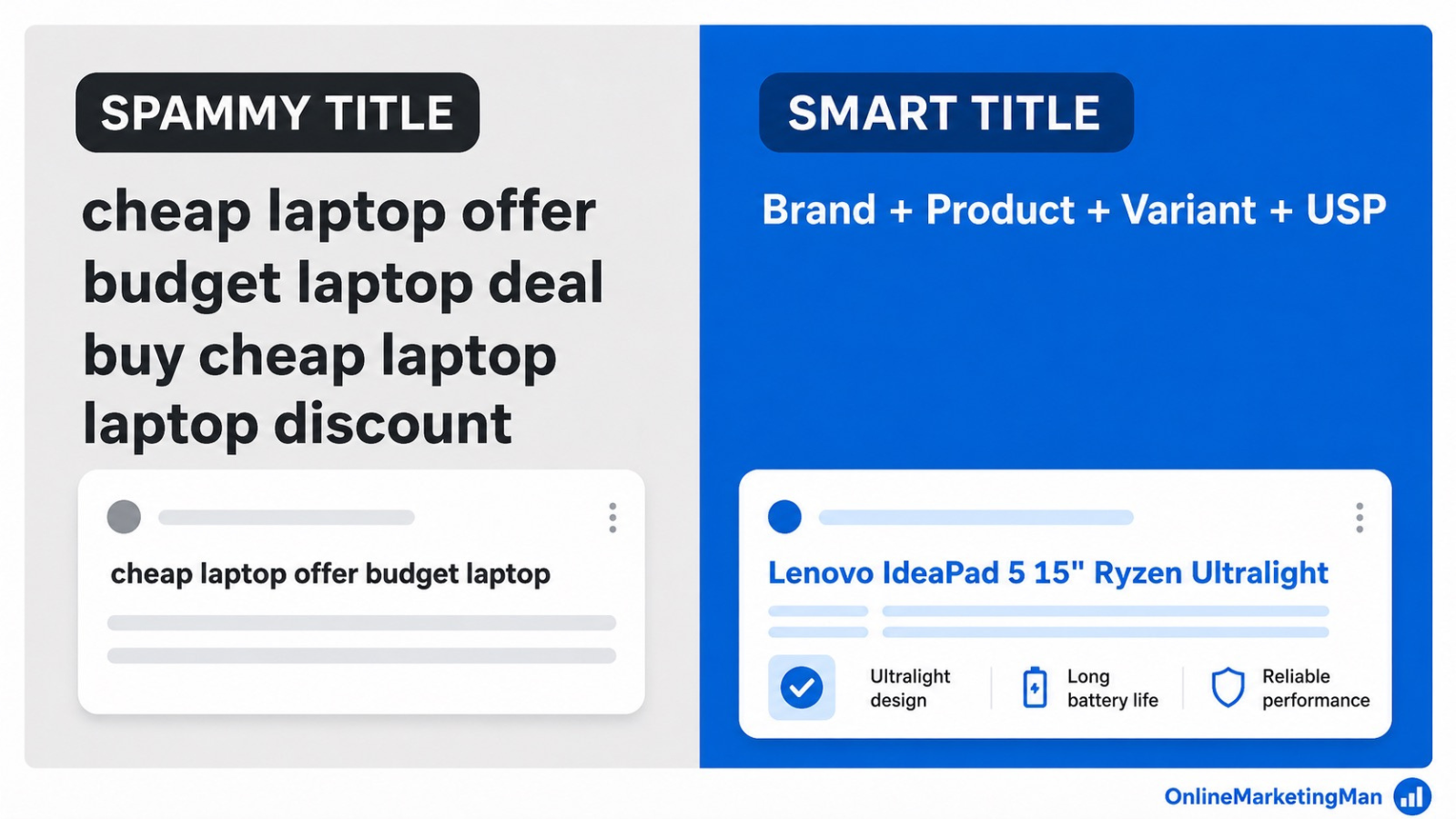
The strongest titles provide exactly enough information to create recognition and confidence. They begin with the attributes users rely on to identify the product and then add the elements that distinguish the variant. Internal codes, duplicate keywords, and generic terms such as “best,” “cheap,” or “sale” rarely contribute to that objective. Specificity usually creates more commercial value than sheer word volume.
From Search Intent to a Fixed Title Architecture
A scalable title architecture starts with a fixed order of information. That order must reflect how customers search and compare, while also relying on product attributes that are recorded accurately in the catalog. The most important identifying element appears first because users and channels process titles from left to right. Additional information only becomes valuable after the brand, product type, and model are already clear.
For most categories, an effective title consists of four functional building blocks:
- Recognition – brand and product type
- Specification – model, series, or configuration
- Variant – color, size, weight, or another selection parameter
- Proof – one relevant feature that functionally differentiates the product
These building blocks are not a rigid formula that is completed in exactly the same way for every product. They form a decision structure that defines which attributes are required for each category and in what order they appear. A laptop, for example, requires different specifications than a padel racket, while both still follow the same logic of recognition, differentiation, and proof. This keeps the architecture centrally manageable without ignoring category-level differences.
Title length follows from that information hierarchy and should never become a goal in itself. A shorter title is not automatically better when a critical variant is missing, and a longer title is not automatically stronger when it repeats the same meaning. Useful length also varies by channel and screen format. The practical rule is that every added word should have a clear function in discoverability, selection, or trust.
Variant Logic and Channel Consistency Reduce Commercial Noise
Variants are often treated as a technical detail even though they contain a large share of purchase intent. A customer is not simply looking for a running shoe, monitor, or padel racket, but for a specific configuration with a particular size, color, capacity, balance, or compatibility. When that information is missing, several product pages look too similar and the user still has to verify after the click whether the correct product is available. That increases abandonment, incorrect selection, and unnecessary returns.
Variant logic also helps reduce internal SEO cannibalization. When multiple URLs use nearly identical titles, it becomes more difficult to determine which page should match a specific query. Search engines may cluster or alternate variants, while paid campaigns fail to recognize enough distinction between products. A clear variant label makes each page more semantically specific and improves product-level reporting at the same time.
The same logic must continue across the storefront, product feeds, and marketplaces. This does not mean every channel must display exactly the same title, because length limits and classification rules differ. It does mean that every channel variant should be built from the same core data and terminology. Only then can performance differences be attributed to channel choices rather than inconsistent naming.
A central title structure also prevents teams from manually maintaining the same catalog multiple times. The storefront can use a readable base title, while Google Shopping or a marketplace receives a controlled extension with additional specifications. Because both versions come from the same product data, model, variant, and product type remain consistent. This makes distribution faster, errors easier to trace, and optimization scalable.
Category Logic and Data Quality Determine What a Title Can Carry
A universal title structure for every product category does not work because customers select on different attributes in different markets. In fashion, audience, color, and size often play a decisive role, while electronics rely more heavily on model number, capacity, and generation. In sporting goods, weight, balance, material, or skill level may determine the choice. The central architecture must therefore support category-specific attributes without abandoning its general logic.
| Category | Logical title structure | Primary variant |
|---|---|---|
| Fashion | Brand + product type + audience + color + size | Size and color |
| Electronics | Brand + model + capacity or core specification + generation | Model and capacity |
| Sports | Brand + product type + model + weight or balance | Configuration |
The table shows that title architecture always depends on the quality of the underlying attributes. A title rule can only work reliably when brand, model, color, size, and other product characteristics are recorded consistently. When values such as “black,” “blk,” “charcoal,” and “anthracite” are mixed without a clear classification model, every automated title rule produces new inconsistency. Product title optimization therefore often begins with normalization of product data and taxonomy.
Data quality also determines how much free-form text is still needed. A mature catalog builds most of the title from structured fields and limits manual additions to exceptions that cannot be derived from data. This allows changes to be made centrally and rolled out under control across thousands of products. New channels then benefit from the same foundation instead of requiring another separate naming project.
Test and Measure Without Creating a New Exception Layer
A/B testing can improve title architecture, but only when the test is based on a clear structural hypothesis. The goal is not to find the most creative wording for each product, but to determine which order or attribute within a category produces better commercial outcomes. A useful test therefore compares representative product groups within the same category, price range, and traffic source. This makes it easier to isolate the effect of the title from other factors.
Evaluation cannot stop at click-through rate. A higher CTR without a higher conversion rate may indicate that the title is too broad or too attractive and therefore draws less relevant traffic. Revenue per session, margin, return rate, and incorrect variant selections provide a more complete view of actual value. Operational indicators, including manual corrections and rejected feeds, should also be included in the assessment.
The outcome of a test should be translated into an adjustment to the category or channel rule. When only individual winners are retained, the catalog becomes a collection of exceptions that cannot be managed centrally. The right question is therefore not which individual title won, but which rule consistently produced stronger results. This turns experimentation into part of the architecture instead of a source of new fragmentation.
A measurement framework also makes internal discussions more objective. Marketing can assess discoverability and click behavior, while e-commerce and finance evaluate conversion, revenue, and margin. Product management and operations can add returns, data quality, and rework. Bringing those perspectives into one evaluation makes product title optimization a company-wide decision rather than the preference of a single team.
Governance and Technical Controls Keep the Structure Intact
Title architecture only remains effective when ownership, decision-making, and control are explicitly defined. Marketing, e-commerce, product management, and data teams all influence the product title, but not every team should be able to change the core structure independently. There should be one owner for the overall architecture and clear responsibility for each category. Exceptions require justification because every exception affects future scalability and maintenance.
Version control is essential. When a title rule changes, the organization should be able to see why the change was made, which products are affected, and which hypothesis is being tested. A rollback option is also required when a new rule produces unexpected effects in feeds, search results, or marketplaces. Without that process, title optimization turns back into manual repair work.
Governance is what separates a temporary cleanup from a permanently scalable title architecture.
Technical validation must extend beyond the title itself. Title, image, price, availability, canonical URL, and structured data should all refer to the same product variant. If the title names a black configuration while the image shows another color, users immediately lose confidence. If Product and Offer markup describes a generic product while the visible title identifies a specific variant, semantic consistency also weakens for platforms.
Internal search and filters benefit from the same discipline. When product types, models, and variants are recorded in one consistent way, search results can be ranked more accurately and filters can be applied more reliably. Internal search data then reveals which attributes customers miss or phrase differently from the catalog. That information should flow back into attributes and title rules rather than remaining in isolated keyword lists.
From Title Chaos to Scalable E-Commerce Implementation
Implementation starts with an inventory of existing titles by category, channel, and responsible team. Differences in order, terminology, variant labeling, promotional additions, and missing attributes are documented. The objective is not to rewrite every title immediately, but to expose patterns and root causes. This makes it possible to distinguish functional differences from practices that exist only because of historical decisions.
A core structure is then defined for each category, including required and optional fields. The product database must be able to provide those fields reliably; otherwise data quality is addressed first. The rule is then tested on products with high revenue, significant traffic, or large advertising spend. That selection makes commercial effects visible faster without changing the entire catalog at once.
After validation, the rule set is rolled out centrally across the storefront and channels. Controls at import, publication, and feed distribution prevent products from going live with missing attributes or incorrect variants. Deviations are recorded so recurring issues can be resolved at the source instead of being repaired repeatedly in the title. The organization thereby shifts from corrective work to structural management.
Management does not stop after the first rollout. Search behavior, assortment, channel rules, and product categories change over time, which makes periodic evaluation necessary. New insights may lead to revised sequences or additional attributes, but every change remains part of the same architecture and governance. This allows the title structure to evolve without breaking apart into isolated exceptions again.
Product titles become truly valuable when they are part of a broader commercial system. The gains do not come from one cleverly written title, but from the consistent connection between product data, search intent, variant logic, channel output, and measurable results. An organization that manages that connection reduces rework, prevents internal cannibalization, and makes analysis more reliable. Title architecture is therefore not an isolated SEO project, but infrastructure for scalable e-commerce.
Schedule a Teams Call (see top) to determine how product data, title rules, and channel distribution can be better aligned within your e-commerce environment.
Related Articles on Strategy, Automation and Growth:
Variant SEO: Titles,
Structured Data And
Images That Actually Rank

Product titles only perform when they are part of a broader SEO architecture. Structured data, internal linking and visual optimization together determine whether product variants achieve sustainable visibility in search.
Data Quality Behind
High-Performing
Product Titles

Clickable titles lose impact when the underlying product feed is incomplete or inconsistent. This article explains how clean product data strengthens search visibility, ranking stability and conversion performance.
Why Tracking SEO
Performance Is Critical
For Product Title Optimization

Without structural monitoring of rankings, CTR and conversion behaviour, title optimization becomes guesswork. This article explains how measurable performance data guides effective product title improvements.
OnlineMarketingMan
Build. Automate. Expand.