
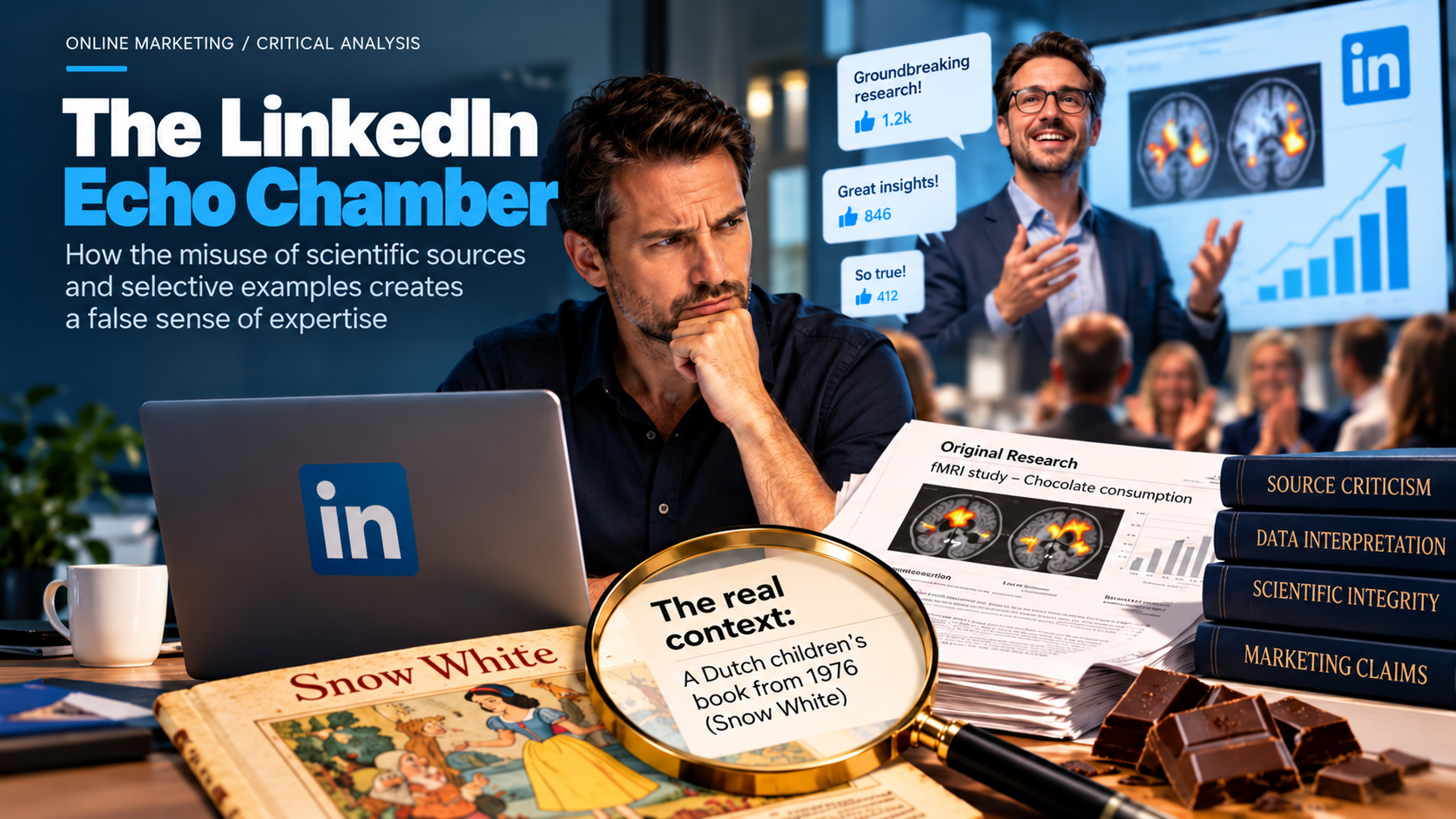
The LinkedIn Echo Chamber: Why Experts Disappear When Substantive Questions Begin
In the LinkedIn echo chamber, expertise is increasingly a matter of presentation. A convincing image, a familiar psychological concept, and a few sentences about the human brain can make a post appear scientifically sophisticated. Yet when someone asks critical questions about the facts behind those claims, they may discover how little room there is for dissent in what looks like a professional discussion. The problem is not making marketing knowledge accessible. It is confusing accessibility with evidence.
In my earlier article, The Devaluation of Marketing: When Gut Feeling Wins Over Facts, I examined a LinkedIn infographic about the historical price development of the Big Mac. That case involved questionable source attribution, inconsistent figures, and an abundance of psychological explanations that could not make up for missing evidence. Last week, I came across two more examples in posts by Hein Heijen of the Academie voor Gedragskennis, a Dutch behavioral-knowledge training organization. This time, the issue was not just the quality of the content. It was also how substantive criticism was handled, as I experienced it.
From an Attractive Post to an Untouchable Narrative
The mechanism behind this kind of LinkedIn publication is simple and effective. A familiar subject is linked to a surprising psychological explanation, leaving readers feeling that they have learned something important. The format is designed to be understood and shared quickly; there is nothing inherently wrong with that. But when simplification omits a material fact, it does more than shorten an explanation. It changes its meaning.
That distinction matters because the author is not presenting himself merely as an entertainer or storyteller. He is using knowledge of behavior and marketing to establish professional authority. That creates different expectations from those surrounding an entertaining piece of trivia. Anyone using a scientific concept to demonstrate expertise should be able to explain the circumstances in which it applies. Attractive packaging may invite someone to read further, but evidence must carry the argument.
Case 1: A Mandela Effect That Does Not Survive Translation
The first post concerned the Mandela effect: a phenomenon in which many people share the same demonstrably false memory. The illustration was the famous mirror line from Snow White. According to the post, people wrongly remember the Dutch words “Spiegeltje, spiegeltje aan de wand” (“Mirror, mirror on the wall”), whereas the queen in Disney’s original English-language film begins with “Magic mirror.” That sounds like a surprising revelation, but it is only the beginning of the analysis.
To understand where this reasoning falls short, we need to revisit the concept’s origins. The Mandela effect takes its name from a collective false memory that became particularly well known in English-language online communities. Some people were convinced that Nelson Mandela had died in prison during the 1980s; some even believed they remembered news reports or footage of his funeral. In reality, Mandela was released on February 11, 1990, after 27 years in prison, was inaugurated as president of South Africa on May 10, 1994, and died on December 5, 2013. The phenomenon is therefore not merely about misquoting a line from a movie. It is named after a supposed memory of a historical event that never happened.
Dutch media history makes that Anglo-American origin particularly relevant. Dutch broadcasters extensively covered Mandela’s release in February 1990. His presidency from 1994 onward was also major news. On July 11, 2010, he was seen around the world entering the stadium during the World Cup closing ceremony, shortly before the final between the Netherlands and Spain. The Dutch national team reached that final, and millions in the Netherlands followed the tournament. For many Dutch viewers, the claim that Mandela had died in the 1980s is difficult to reconcile with the footage they saw for years afterward. That does not make a mistaken memory impossible in the Netherlands. It does mean you cannot assume, without research, that this particular misconception from the English-speaking world has the same prevalence or cultural significance among Dutch audiences.
The post, however, was aimed at Dutch speakers. In the Netherlands, the famous mirror line is known not only from Disney’s 1937 English-language movie but also from the fairy tale, Dutch retellings, children’s books, and later Disney communications. The phrase “Spiegeltje, spiegeltje aan de wand” genuinely appears in Dutch editions of Snow White and has even been used by Disney Netherlands in promotional material about the story. Remembering those words is therefore not automatically a false memory. It may be entirely accurate for the Dutch-language version someone grew up with.
This is why the example is substantively problematic. Before describing a shared memory as false, you must establish what the people concerned actually saw, heard, or read. Comparing the recollection with the English film script does not prove that a Dutch viewer is remembering a Dutch fairy-tale text incorrectly. The relevant question is not whether “Magic mirror” appears in the original Disney movie. It is which source you use as your reference point and whether it is appropriate for your audience.
There is an important nuance that would actually strengthen a serious analysis: not every Dutch translation, subtitle track, or dubbed release necessarily uses identical wording. Comparing Dutch movie versions, subtitles, and book translations would help identify where any confusion originated. That distinction was missing from the quick conclusion I read on LinkedIn. An American example cannot be copied without context as though language, culture, and publication history are irrelevant.
The parallel with widely circulated American Snow White lists is particularly revealing. In the United States, the example contrasts the familiar expression “Mirror, mirror” with “Magic mirror” in the English-language Disney film. Presenting that comparison as proof of a collective Dutch memory error merely transfers the American example without doing the necessary linguistic and cultural checking. The result resembles material lifted directly from an English-language AI overview or US content template. That does not prove the writer used AI. It does show why literal translation without local source verification is not reliable knowledge transfer. An American false memory does not automatically become a Dutch false memory just because the words have been translated.
A memory can only be shown to be false once you establish which reality it is being compared with.
Even the accompanying illustration raised questions. Instead of a recognizable depiction of the queen from Snow White, I saw an image more reminiscent of Maleficent from another Disney adaptation. That is not evidence that the entire post was written by AI, nor is it the main argument in this case. It does illustrate why a final visual check is essential when a specific cultural story is presented as supporting evidence.
Case 2: The Chocolate Study That Became Interesting Where the Summary Ended
The second example cited an fMRI study of advertising for chocolate bars. The study was conducted by Simone Kühn, Enrique Strelow, and Jürgen Gallinat and published in NeuroImage in 2016 under the title Multiple “buy buttons” in the brain: Forecasting chocolate sales at point-of-sale based on functional brain activation using fMRI. It asked a relevant question: can brain signals recorded while people view advertising predict subsequent changes in store sales better than participants’ explicit ratings of how much they like the ads? That is substantially different from the general observation that consumers do not buy everything they enjoy looking at.
The research design went well beyond a stand-alone survey or a handful of brain images. Participants saw six chocolate advertising executions and product images before and after exposure. Researchers examined fMRI signals in preselected brain regions, including the nucleus accumbens and parts of the prefrontal cortex, and compared predictions with a subsequent supermarket test. That in-store test involved 63,617 shoppers; it was the size of the store test, not the number of people placed in an MRI scanner. The distinction between measuring brain activity, forecasting outcomes, and recording actual sales is exactly where this study’s scientific value begins.
According to the publication, the fMRI signals recorded during exposure to the advertising predicted sales changes better than participants’ explicit assessments of how appealing they found the materials. Brain responses to product imagery before and after the advertising provided another route to prediction. That finding is considerably more interesting than the marketing truism that liking an ad and buying a product are not the same thing. It concerns the potential incremental predictive value of neuroimaging in a specific research design—not a universal button that can control the buying decisions of individual consumers.
It is equally important to recognize the study’s scientific boundaries. Researchers selected several brain regions based on prior hypotheses; the summary does not establish that any single area independently predicts every sales outcome. Terms such as nucleus accumbens and prefrontal cortex are not decorative proof points to sprinkle into a LinkedIn post. They refer to a particular measurement design, theoretical choices, and limitations that need to be understood before drawing commercial lessons.
What the Study Actually Shows—and What It Does Not
What remained from the LinkedIn post I read was the safe conclusion that liking advertising does not automatically lead to a purchase. That is not wrong, but it is far too limited to explain the study’s central contribution. If a writer cites a scientific paper specifically to establish authority, readers can reasonably expect something beyond a line any first-year marketing student would agree with. Otherwise, science becomes little more than an impressive label.
| Aspect | What the simplified post emphasizes | What the study actually investigates |
|---|---|---|
| Research question | Liking is not the same as buying | Which signals predict changes in retail sales? |
| Method | A reference to brain scans | fMRI measurements, preference ratings, and a separate store test |
| Principal finding | Ad appreciation is insufficient | In this setting, fMRI signals predicted sales better than explicit ratings |
| Limitation | Barely discussed | Specific products, messages, measurement decisions, and test conditions |
That comparison explains why the missing depth matters. The interesting question is not whether feelings and purchases can diverge. It is which measurements add value to existing market research methods, and under what circumstances. The study does not become worthless just because it is cited in a commercial context. It is misused when the authority of science is made to sound greater than the meaning of its results.
From Scientific Citation to Commercial Funnel
I noticed the same pattern in both posts. A familiar psychological phenomenon or scientific publication supplied the hook, an easy-to-remember conclusion filled the middle, and a reference to the author’s own training programs provided the commercial destination. There is nothing inherently wrong with an educator promoting training products. An article, webinar, or course does not have to be free of commercial interests to offer genuine value.
The problem arises when a citation is used mainly to suggest that the author is knowledgeable, while the content barely explains what was actually researched. Readers are asked to invest attention in what seems to be a deep insight, only to receive a familiar generalization wrapped in scientific language. However attractive a course may look, the marketing funnel must not replace the scientific explanation used to lead people into it. Authority does not come from repeatedly telling an audience how much you know about the brain.
The Substantive Questions That Then Disappeared
Under both LinkedIn posts, I raised questions about the evidence. With the Snow White example, I asked about the Dutch-language context and whether the alleged false memory could actually be demonstrated here. With the chocolate study, I asked about the research results, the brain regions involved, and the gap between the actual findings and the post’s broad conclusion. These were critical questions, but they followed directly from the claims used to attract readers in the first place.
What I subsequently observed through my account was that my comments disappeared and I could no longer contact the LinkedIn user concerned. I experienced this as the removal of my criticism and the blocking of my account. I cannot independently establish the exact technical or personal circumstances, or prove why the account owner acted as they did. For the substantive discussion, however, the visible outcome is straightforward: those specific questions received no public, verifiable answer.
Authors are entitled to moderate comments. Professional channels do not have to tolerate insults, spam, personal attacks, or persistent disruption. But a factual correction or a request to examine the cited source belongs in a different category. People who present themselves as knowledge authorities can strengthen their credibility by explaining why a challenge is unfounded, correcting a mistake, or acknowledging that an example was oversimplified.
A critical question is not a threat to expertise. It is an opportunity to demonstrate that the expertise is real.
Why the LinkedIn Echo Chamber Reinforces Itself
This dynamic is not solely the responsibility of one writer. LinkedIn rewards visibility, posting consistency, interaction, and recognizable viewpoints, whereas detailed source verification requires time and concentration. An approving comment takes seconds to write; reading the original study may take an hour. The result is a structural tension between content that performs well socially and the work needed to assess whether a claim is justified.
Followers contribute to the dynamic, too. Complimenting a popular expert signals to one’s own network that one shares the same professional vocabulary. Posting a pointed correction, by contrast, risks being perceived as difficult—even if the question is factually sound. Public discussion can thus gradually become a stream of affirmations that projects substantial social authority while generating surprisingly little new knowledge.
Generative AI can accelerate the process. Reworking an existing American list, a brief study summary, or a polished visual for a Dutch-speaking network has become easier than ever. That does not establish that either of the posts discussed here was created with AI, and it need not do so to expose the weakness. The risk begins when speed and presentation outrun checks on the source, context, and meaning.
The Block Button Reveals No Motive, but It Leaves a Knowledge Gap
It would be tempting to infer directly from a block that someone fears exposure or deliberately protects a fragile business model. That would sound forceful, but without knowing the person’s reasoning it would be speculation. What can be assessed are the original statements, the specific questions, and the lack of a visible substantive response. An article warning against pseudo-expertise should not make the same mistake by presenting unproven motives as established psychology.
That does not make the case irrelevant. Professional discussions are not improved by leaving only supportive comments visible. When specific objections about a translation or a scientific study disappear, the public loses the opportunity to evaluate them independently. Even if moderation took place for other reasons, it remains good practice to respond to verifiable criticism somewhere in substance.
What Genuine Marketing Expertise Looks Like
Marketing does not need more sweeping claims about the power of the subconscious. It needs professionals who explain clearly what a study does and does not establish, who avoid translating cultural examples without checking them, and who respect the limits of their conclusions. Experts do not have to know everything; they make mistakes like anyone else. The difference lies in their willingness to show the evidence and revise their interpretation when necessary.
In practice, that requires a small but demanding set of professional habits:
- Check the original source, not merely its viral summary;
- Specify the language, audience, and research context to which a claim applies;
- Distinguish actual findings from interpretations and commercial promises;
- Answer substantive criticism with evidence or a transparent correction.
These habits may not sound exciting, but that is precisely their strength. They prevent marketing jargon from replacing research and popular concepts from becoming an excuse for weak conclusions. An agency, training provider, or independent specialist that explains its work this way gives the audience something an algorithm cannot guarantee: the ability to test the reasoning independently. That is a more persuasive form of authority than another infographic featuring an illustration of the brain.
The Damage Caused by Pseudo-Expertise Extends Beyond One LinkedIn Post
The central problem is not that a Dutch Disney example was framed incorrectly or that a scientific paper was summarized too briefly. Such errors can be corrected. The deeper damage emerges when a profession grows accustomed to treating precision as optional as long as the packaging is convincing. Knowledge is then judged by reach, reactions, and the presenter’s apparent status rather than the reliability of the argument.
For business owners, marketing teams, and students, that is not an abstract concern. They make decisions based on advice, buy training programs, commit budgets, and adopt concepts that appear authoritative on LinkedIn. When these concepts circulate without context or verification, poor analysis can become an accepted professional standard. The costs rarely appear in the comment thread where the story began.
There is therefore one simple question worth asking more often before liking or sharing an attractively packaged expert post: what exactly supports this claim? Not to derail the conversation, but to take the content seriously. Those who treat the question as a normal professional invitation strengthen the marketing profession. Those who keep it out of sight miss an opportunity to substantiate their claimed expertise.
The Value of Expertise Becomes Clear When It Is Challenged
These two LinkedIn cases show how wide the gap can be between a surprising story and a carefully supported explanation. The Mandela effect calls for scrutiny of language and source context; the fMRI study requires an account of the actual research design and the limits of the findings. In both cases, the genuinely interesting material was readily available. That is what makes it disappointing when the conversation never gets beyond a quick one-liner.
I do not expect every LinkedIn post to become a scientific paper. I do expect people who invoke scientific authority to promote training programs or expertise to be willing to answer basic questions about their examples. Criticism does not automatically make the critic right, but deleting criticism is not a substantive rebuttal either. Marketing becomes more credible when we take that distinction seriously again.
The best test of an expert is not how many people applaud when they make a claim, but how much of that claim survives when someone asks why.
Related Articles on Marketing Expertise, Source Criticism, and Misleading Claims:
THE DEVALUATION OF MARKETING THROUGH PSEUDO-EXPERTISE

A Big Mac comparison spanning 42 years reveals how selective figures, incompatible price definitions, and questionable source references can create a convincing but misleading marketing narrative. Discover why factual verification and intellectual rigor matter more than polished presentation and scientific-sounding terminology.
DATA QUALITY THAT SELLS: NORMALIZING AND ENRICHING PRODUCT FEEDS

Reliable marketing performance starts with accurate product information, consistent identifiers, and clearly defined attributes. Explore how structured product data improves search relevance, reduces wasted advertising spend, supports conversion, and creates a more dependable foundation for commercial decisions across multiple sales channels.
FROM DASHBOARDS TO DECISIONS: WHY MORE DATA DOES NOT MEAN MORE INSIGHT

Impressive dashboards and extensive KPI reports do not automatically produce better business decisions. Learn why meaningful analysis requires reliable definitions, relevant context, clear priorities, and decision rules that translate measurable performance into commercially justified action rather than superficial conclusions.
OnlineMarketingMan
Build. Automate. Expand.