
AI Shopping Agents Are Changing E-commerce: Your Online Store Will Soon Sell to Machines Too
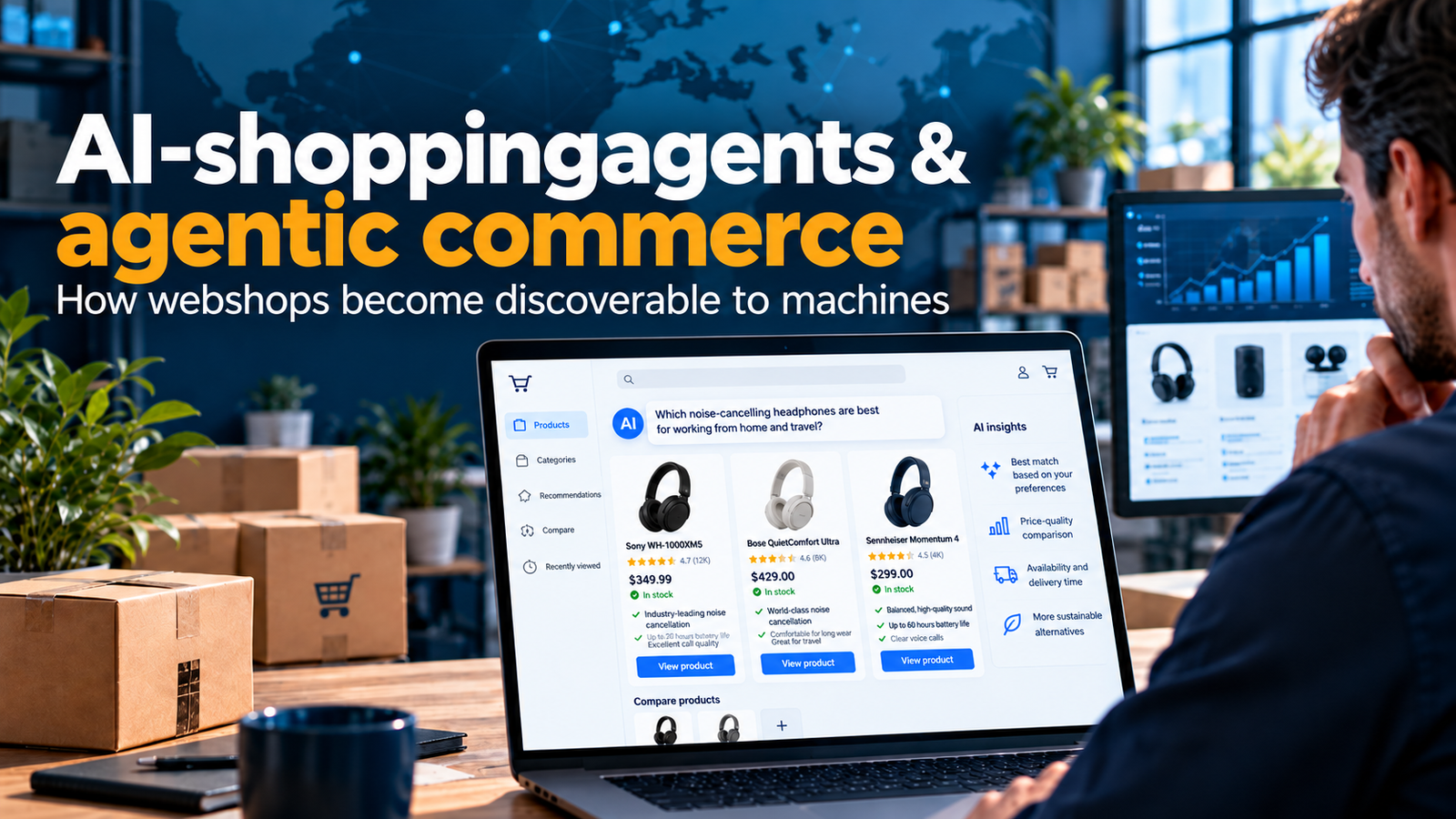
A consumer looking for a product increasingly no longer has to navigate dozens of product pages, comparison sites, and online stores on their own. They can tell an AI assistant what they need, which features matter, what budget is available, and how the product will be used. The AI can then gather options, explain differences, and create a shortlist that goes far beyond a traditional list of search results. That changes more than just the interface where a purchase begins. Until now, online stores primarily optimized for people, search engines, advertising platforms, and marketplaces. With the rise of agentic commerce, a new layer is being added: software that attempts to understand and evaluate products on behalf of a consumer before that consumer ever visits an online store. Your product information is therefore no longer read only by potential customers, but increasingly also by systems that determine which products are presented to that customer in the first place. OpenAI took a clear step in that direction in March 2026 by further expanding product discovery within ChatGPT through the Agentic Commerce Protocol. Users can visually browse products, compare options side by side, and incorporate current product information into their decision-making process. For certain eligible products and merchants, the purchase journey can even continue further within ChatGPT itself. The relevant question for online stores is therefore no longer only how to attract more visitors, but also whether their assortment is understandable, current, and distinctive enough for a system that selects on behalf of the customer.From Search Query to Purchase Request
A traditional search engine primarily responds to a search query. A user might type “best control padel racket” and receive pages, ads, stores, and comparisons from which they must make their own selection. An AI shopping agent can process the same need much more specifically. The consumer can indicate that they are an advanced player, value control more than maximum power, are sensitive to arm strain, and do not want to spend more than €180. That difference may seem small, but commercially it changes the division of roles considerably. A search engine mainly helps users find relevant destinations; an AI assistant can combine information before the click, eliminate alternatives, and explain why certain products may be a better fit for the situation. Part of the orientation process that used to take place on category pages, comparison sites, and product pages therefore shifts to an external interface. The online store does not disappear from the customer journey. However, the moment when it enters the picture may come later. The visitor who eventually clicks through may already know which two or three products are relevant, how their features differ, and what price range is realistic. That makes the quality of the information available before the click far more important than in a model where almost every interested visitor first explores the assortment independently.In agentic commerce, you are no longer competing only for the click, but for a place on the shortlist created before that click happens.
What Agentic Commerce Actually Means in 2026
AI and e-commerce discussions often get ahead of what is already technically available. It is therefore important to distinguish between what works today and what is still developing. OpenAI already uses structured product information to find and present products in ChatGPT. The product specification includes elements such as identity, description, images, price, availability, variants, shipping, and return information. Product variants are even expected to have a separate record for each actual purchasable version. That does not mean every online store is automatically being sold through a fully autonomous agent. Direct product feeds are being rolled out in phases, and checkout functionality has separate eligibility and technical requirements. The online store will also remain the final destination for many transactions. The relevant development is therefore not that the traditional e-commerce model is being replaced overnight, but that product discovery can increasingly take place outside the merchant’s own website. The shift becomes clearer when the traditional customer journey is placed next to an agentic model:| Element | Traditional e-commerce | Agentic commerce |
|---|---|---|
| Start of the search | Search engine, marketplace, or online store | Conversational AI with a specific purchase need |
| Product selection | Customer filters and compares independently | AI can preselect and exclude options |
| Product information | Primarily written for human readers and search engines | Must also be machine-readable and contextually interpretable |
| Comparison | Spread across tabs, stores, and comparison sites | Can take place within a single conversation |
| Role of the online store | Discovery, persuasion, and transaction | Increasingly depth, trust, fulfillment, and transaction |
| Competition | Rankings, advertising, price, and conversion | Also relevance to the request and quality of merchant data |
AI Must Understand Why a Product Is Suitable
A product title, image, and price were never enough for strong e-commerce, but in an agentic environment that becomes even more obvious. An AI assistant must do more than establish that a product exists. It must be able to interpret which need the product is relevant to and which characteristics distinguish it from alternatives. That makes product context more important than simply completing mandatory feed fields. Consider the padel racket example again. “Carbon racket, 365 grams, €169” contains factual information, but says very little about which player would actually benefit from it. Balance, core hardness, shape, sweet spot, material, comfort, and playing characteristics can collectively determine whether the same racket makes sense for a defensive player, an attacking player, or someone who prioritizes arm comfort. If that context is not available in a structured or convincing form, an AI system has to infer more on its own or may favor a product whose suitability can be determined more clearly. That does not mean every product page should be overloaded with AI-focused keywords. Quite the opposite. Factual, specific, and coherent information becomes more valuable than copy created primarily to achieve a certain keyword frequency. The existing OMM principles around normalizing and enriching product feeds therefore remain relevant, but gain an additional commercial dimension: good data not only helps a platform technically classify a product, but also helps a buying agent explain why that product is relevant.Product Data Becomes Part of the Sales Argument
This is where an important difference with traditional feed optimization emerges. A strong product feed was traditionally evaluated primarily on technical completeness, channel approval, and the extent to which products could be correctly matched to search queries and filters. In agentic commerce, the same data can directly contribute to answering a purchase question. The distinction between technical product data and commercial content therefore becomes smaller. An AI shopping agent can only compare responsibly when the underlying information is sufficiently complete. For an online store, that means at least four information layers need to align:- Product identity and variants: every purchasable product must be clearly identifiable, including differences in size, color, configuration, or other relevant options.
- Commercial product context: attributes must not merely be present, but provide enough meaning to understand suitability, limitations, and differences.
- Current transaction data: price, inventory, promotions, and availability must reflect what can actually be purchased.
- Merchant terms: shipping, return policies, and other conditions must be clear enough to allow merchants to be compared responsibly.
Current Inventory and Pricing Become Visibility Signals
That operational element matters more than it may initially appear. ChatGPT can show multiple merchants for the same product, and according to OpenAI ranks sellers based in part on factors such as availability, price, quality, and whether the seller is the manufacturer or primary merchant. That means something that once appeared to be primarily a logistics or pricing issue can become part of the commercial presentation within an AI interface. An online store with excellent content but systematically outdated inventory data may therefore face a problem that goes beyond a canceled order. The merchant becomes less reliable as a source for a system that is trying to present current options to a user. The same applies to price differences between the feed, product page, and checkout. In an environment where multiple merchants can be presented side by side, inconsistency becomes visible more quickly. That is why established disciplines such as inventory synchronization at variant level connect directly to agentic commerce without being the same topic. Inventory sync prevents operational errors; agentic commerce increases the commercial consequence of current availability. The infrastructure therefore does not suddenly change in nature, but gains an additional consumer: the AI system that needs current product information to make a relevant recommendation.Shopify Shows That This Shift Is Already Becoming Operational
For Shopify merchants, this development has already become especially concrete. OpenAI indicates that product data from Shopify merchants is already integrated into ChatGPT through Shopify Catalog, allowing products to appear more completely and accurately in relevant shopping conversations. Individual Shopify merchants do not need to build a separate OpenAI integration for this basic form of product discovery. Shopify itself positions its Catalog as infrastructure that makes product information usable for AI shopping interfaces. That requires more than just a product name and price. It may also include category, availability, images, variants, material, size, and color. The catalog therefore becomes a distribution layer between the merchant’s own store and various AI environments. That is beneficial for small and mid-sized online stores because the technical barrier to entry becomes lower. It does not mean every Shopify store will automatically achieve the same visibility. If two merchants offer the same type of product, but one has complete, current, and commercially strong product information while the other relies on superficial supplier copy and missing attributes, those differences remain. A platform can distribute data; it cannot create missing commercial knowledge.AI does not make a weak product catalog intelligent. It mainly makes it easier to see which catalog contains enough information to support a purchase decision.
From SEO to a Broader Form of Visibility
The term GEO, Generative Engine Optimization, is increasingly used for optimization aimed at generative search and answer systems. There is a useful idea behind it, but online stores should be careful not to create another artificially isolated optimization discipline. The fundamental requirements are remarkably familiar: reliable information, clear entities, consistent product attributes, strong technical accessibility, and evidence that the information being offered is accurate. SEO also remains relevant. Search engines do not disappear simply because consumers also use AI assistants, and product pages remain necessary for organic traffic, deeper evaluation, and conversion. The difference is that visibility spreads across more interfaces. Where a product once primarily needed to be understood by Google Shopping, marketplace filters, and on-site search, the same commercial truth must now also be usable by systems trying to answer a complete purchase question semantically. That is why the product feed challenge is broader than ever. Feed distribution and channel mapping already revolved around the controlled distribution of a single product catalog across multiple channels. Agentic commerce does not create a reason to build separate data sources all over again. Quite the opposite: the more sales and discovery channels emerge, the more important it becomes that they are all fed from the same governed commercial truth.Your Own Online Store Does Not Lose Value, but Its Role Changes
An overly simplistic conclusion would be that AI shopping agents make the merchant’s own online store less important. The reality is more nuanced. An agent can be highly effective at selection and comparison, but brand experience, deeper content, trust, advice, service, bundles, loyalty, and relationship building remain valuable on the merchant’s own domain in many categories. The website does not become obsolete; part of the pre-purchase journey may simply take place elsewhere. That may even produce higher-quality traffic. If an AI assistant has already determined that a product fits the customer’s needs in terms of price, use case, and characteristics, the product page has fewer basic questions to answer. The visitor arrives further along in the decision-making process. At the same time, the standard rises: if the information on the website differs from the context the agent previously presented, friction appears immediately. For brands and specialized online stores, there is also an opportunity here. Generic merchants compete heavily on price and reach, while specialist stores often possess knowledge that allows products to be matched much more accurately to specific use cases. If that knowledge exists only in a salesperson’s head or in isolated blog posts, a shopping agent cannot use it structurally. If it becomes part of product data and meaningful product context, that expertise becomes more scalable.The New Competitive Battle Also Takes Place Between Merchants
Agentic commerce therefore changes not only the competition between products. Sellers offering the same product also become easier to compare. Availability, current pricing, shipping conditions, and merchant quality can all influence which seller is displayed most prominently. A strong product position does not automatically translate into the same level of visibility for every retailer. That makes operational maturity more commercially visible. An organization that consistently maintains high-quality product data, processes price and inventory updates quickly, and provides clear conditions has a better chance of becoming a reliable source than an online store selling the same products while constantly struggling to keep its own information current. What was internally treated for years as back-office quality can therefore start influencing product discovery directly. For dropshipping and other models in which the online store depends heavily on external suppliers, this becomes especially relevant. A merchant can only publish current information when the supplier provides sufficiently reliable data and changes are processed quickly. A technically automated dropshipping model with delayed inventory or inconsistent variant data may therefore become more vulnerable as AI systems place greater demands on current commercial information. API-first dropshipping does not become more relevant simply because AI is popular, but because agentic commerce works poorly with data that has to be corrected manually after the fact.What Should an Online Store Actually Prepare Now?
There is little value in buying new software every time a new AI feature appears. The strongest preparation consists of getting the fundamentals right in areas that create value even without agentic commerce. When the foundation is solid, the same infrastructure can be used for search engines, marketplaces, advertising, owned channels, and new AI distribution. For a practical readiness check, five questions are enough:- Can every purchasable product and every relevant variant be identified clearly, both technically and contextually?
- Are price and availability reliable enough to be used as current commercial information outside the online store?
- Does the catalog contain enough specific attributes to explain not only what a product is, but also which need it is suitable for?
- Are shipping, return conditions, images, and other decision-making information available in a structured and consistent way?
- Can you determine which source is authoritative when the online store, supplier, feed, and external channel contradict one another?
Who Will Own the Customer Relationship?
Alongside visibility, a more strategic question emerges. As more orientation, comparison, and potentially checkout take place outside the merchant’s own domain, part of the customer interface shifts to external platforms. That is not fundamentally new; marketplaces and social commerce raised the same discussion before. AI assistants can deepen that shift because they do more than provide a sales environment: they become an active part of the decision-making process. Online stores therefore need to consciously determine which value they want to make available outside their own domain and which value should remain a reason for the customer to visit their own environment. Product data should be widely distributable, while expertise, service, community, loyalty, and brand experience can remain distinctive owned assets. The balance differs by category. A standardized product requires a different customer journey from a product where advice, configuration, or expertise represents a large part of the value. Measurement also needs to adapt. If a consumer spends the first fifteen minutes of product research inside an AI interface and then goes directly to a single product page, the website path tells only part of the commercial journey. That requires caution when drawing conclusions about attribution, content usage, and the value of top-of-funnel pages. Fewer page views before purchase do not automatically mean the customer used less information; they may simply have received that information elsewhere.Agentic Commerce Makes Commercial Infrastructure More Visible
The most important change created by AI shopping agents is therefore not that online stores now need to be built for robots instead of people. People remain the customer, determine their preferences, and bear the economic risk of the purchase. What changes is that a machine-based system can increasingly influence which products and sellers that customer seriously considers in the first place. Competition therefore shifts partly from interface to infrastructure. Product data must not only be complete, but meaningful. Inventory and pricing must not only be updated internally, but be reliable enough for external use. Shipping and return conditions must not merely exist for legal reasons, but be understandable and consistent. Specialist knowledge must not exist only in isolated content, but where possible be reflected in how products are described and classified. For e-commerce organizations that already take that foundation seriously, agentic commerce does not have to mean a radical rebuild. It is better understood as a new distribution layer built on the same principles of data quality, automation, and operational control. For organizations that have been able to grow for years with inconsistent feeds, manual exceptions, and superficial product information, the development will be more confronting. An AI agent has no patience for internal explanations about why inventory is “usually accurate.” The strategic question for 2026 is therefore not whether every consumer will soon let an AI agent shop fully autonomously on their behalf. The relevant question is whether your online store is ready for a market in which an increasing share of product discovery can take place before anyone visits your website. When product context, pricing, inventory, terms, and merchant information can be shared as one reliable commercial layer, agentic commerce can become an additional growth channel. When that foundation is missing, AI mainly exposes where the e-commerce architecture is not yet mature enough.Related Articles on AI, Product Data and E-commerce:
Why E-commerce Marketing Fails When Product Data, Inventory and Supply Chain Fall Out of Sync

Product data, inventory and suppliers determine whether a commercial promise can actually be fulfilled. That operational reliability becomes even more important when AI systems start comparing and selecting products.
From Supplier Feed to Sellable Assortment: Turning Product Data Into Commercial Decisions

A product is only truly sellable when inventory, delivery, margin and risk are strong enough together. Discover how raw supplier data becomes a commercial decision-making system.
Why Professional Dropshipping Depends on Reliable Data, Margins and Operational Control

Professional dropshipping is not about publishing as many products as possible. It depends on reliable suppliers, healthy margins, operational control and scalable e-commerce processes.
OnlineMarketingMan
Build. Automate. Expand.
© 2026 OnlineMarketingMan. All rights reserved.