
Behind the Scenes of E-Commerce: Why Marketing Fails When the Supply Chain Breaks Down
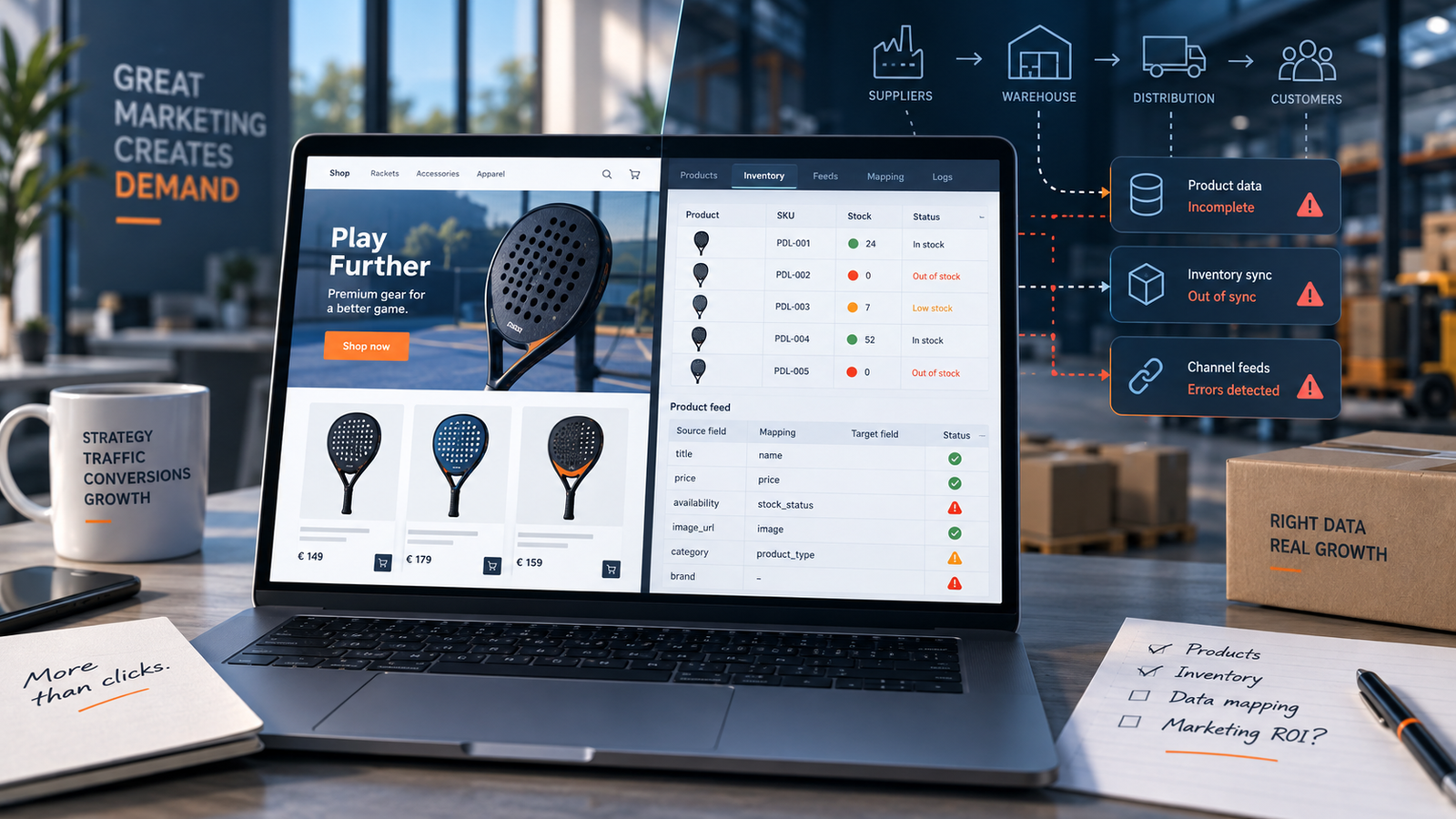
In e-commerce, a remarkable amount of attention goes to what the customer can see. We optimize ads, product pages, customer journeys, checkout flows, and conversion rates, while dashboards show with increasing precision where visitors drop off and which campaigns generate revenue. That work matters, but it represents only the front end of the commercial system. Behind every click is a far less visible chain of product data, inventory, suppliers, purchasing terms, and system integrations. When that back end is unreliable, strong marketing can actually make the problem worse by generating additional demand for products that cannot be supplied—or cannot be supplied profitably.
That became clear again recently during an inventory and data operation for a specialized Dutch online retailer in high-end sports equipment. The assortment consists of more than four hundred models and variants that depend to a significant extent on a major international supplier. For an assortment of that size, current inventory is not an administrative detail. When a customer orders a specific model that appears to be available in the online store but can no longer be supplied through the B2B purchasing channel, a successful conversion still ends in a cancellation, refund, and disappointed customer. The e-commerce supply chain therefore directly determines whether the commercial promise made at the front end can actually be fulfilled.
What initially looked like a routine inventory synchronization revealed how many different systems sit behind a seemingly simple stock status. Product names were not identical everywhere, unique item numbers were unavailable in some data sources, EAN codes did not always align, and the supplier’s public consumer website sometimes presented a different commercial reality from its B2B portal. These are not exotic exceptions that only occur with poorly organized small suppliers. Larger e-commerce organizations can also accumulate a data landscape through years of system growth, different sales channels, and separate databases in which the polished front end looks far more consistent than the infrastructure behind it.
Inventory Synchronization Is Not an Administrative Detail
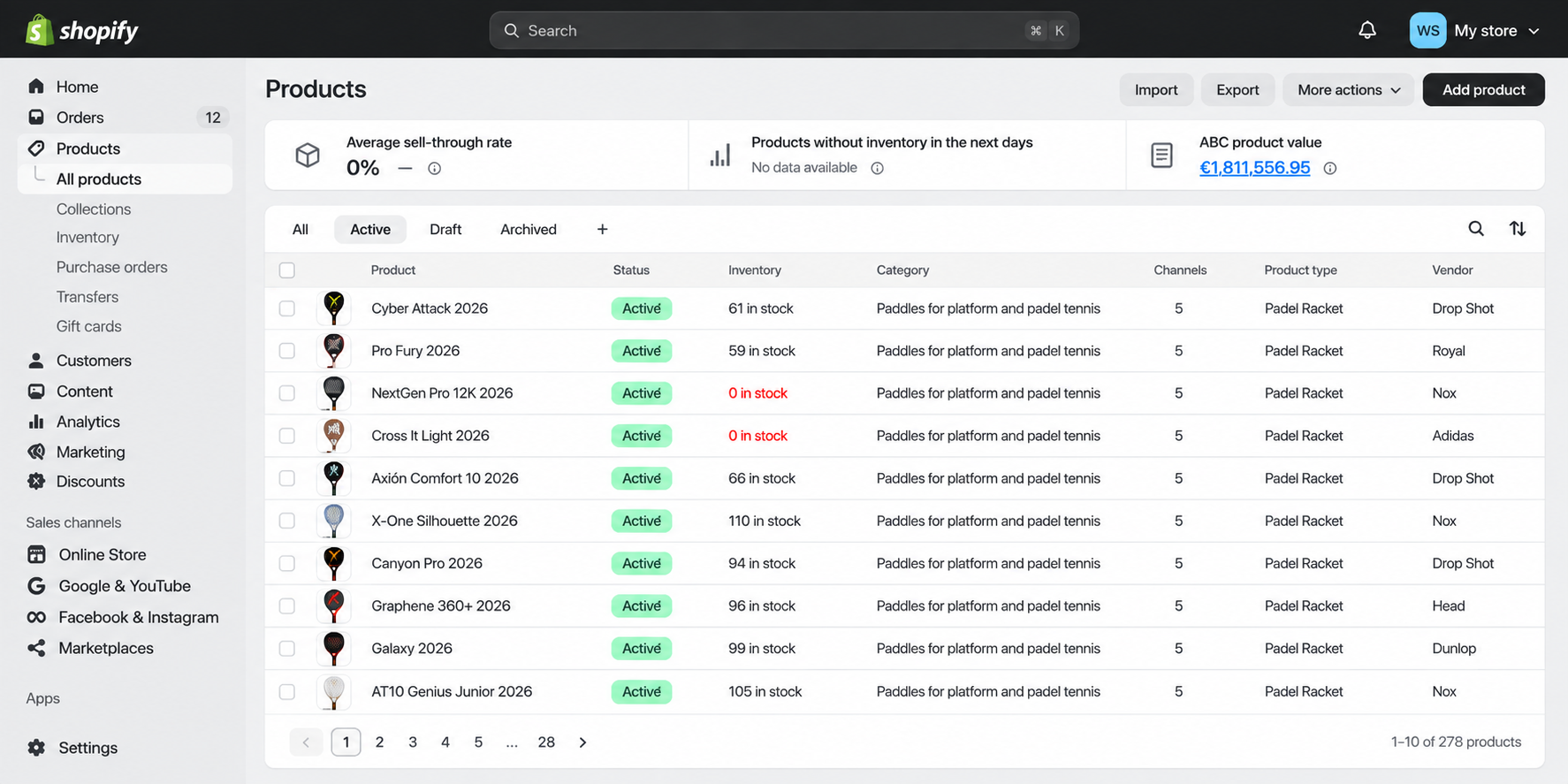
Inventory management is still too often treated as an operational process that sits apart from marketing. In reality, availability is part of every commercial promise an online store makes. An ad can reach exactly the right audience, a product page can convert exceptionally well, and the checkout can function perfectly, but all of those optimizations lose their value when the product turns out to be unavailable after the order has been placed. The advertising costs have already been incurred and the customer expectation has already been created, while the transaction itself still has to be reversed.
That makes inventory quality directly relevant to conversion, customer service, reputation, and customer value. A canceled order not only creates extra work for the retailer, but may also mean that a new customer’s first experience with the brand begins with disappointment. If that same customer is later targeted again through paid media, the company may effectively be paying a second time to rebuild trust that was damaged by an incorrect stock status. A reliable inventory connection is therefore not an administrative layer beneath marketing, but a condition under which marketing can function economically at all.
For an automated connection to work, different systems must be able to identify the same product unambiguously. A product name alone is rarely sufficient, particularly when the supplier and retailer use their own naming conventions. In practice, it should at minimum be clear which technical identifier follows a product throughout the entire chain:
- an SKU or other unique item number that can be recognized in both systems;
- an EAN or GTIN where one is available and reliable;
- a consistent link between model, configuration, and variant;
- a direct relationship between the identified item and its actual B2B inventory.
As long as those identifiers match, much of the process can be automated. As soon as one system uses a different identifier or does not contain an essential identifier at all, the same synchronization turns into a far more complex data operation. The main problem is no longer the speed of the feed, but whether both systems can even establish with certainty that they are referring to the same product. That distinction is critical because a fast connection to the wrong item can be operationally more dangerous than a slower connection that is verified first.
When the Same Product Means Something Different in Two Systems
In practice, that was exactly where an important bottleneck emerged. Item numbers that were visible on the supplier’s public product pages were missing from parts of the B2B data. Some products had a usable EAN, while others did not, and product titles differed between the retailer and supplier in word order or additional wording. A model built internally according to one fixed naming structure may, for example, contain the same brand and model name on the supplier side, but in a different order or with an additional commercial designation. An employee can often recognize immediately that both records refer to the same item, but that relationship is far less obvious to software.
An Excel function such as XLOOKUP works very well when both files share one consistent key, but it cannot independently determine that two different product titles semantically represent the same product. If the item number is also missing on one side and the EAN is not consistently available, the remaining solution is ultimately a manual mapping layer in which hundreds of records have to be linked one by one. That is the point at which what looked like a straightforward inventory check turns into data management. Not because Excel or the online store is inadequate, but because automation cannot create certainty without a reliable key.
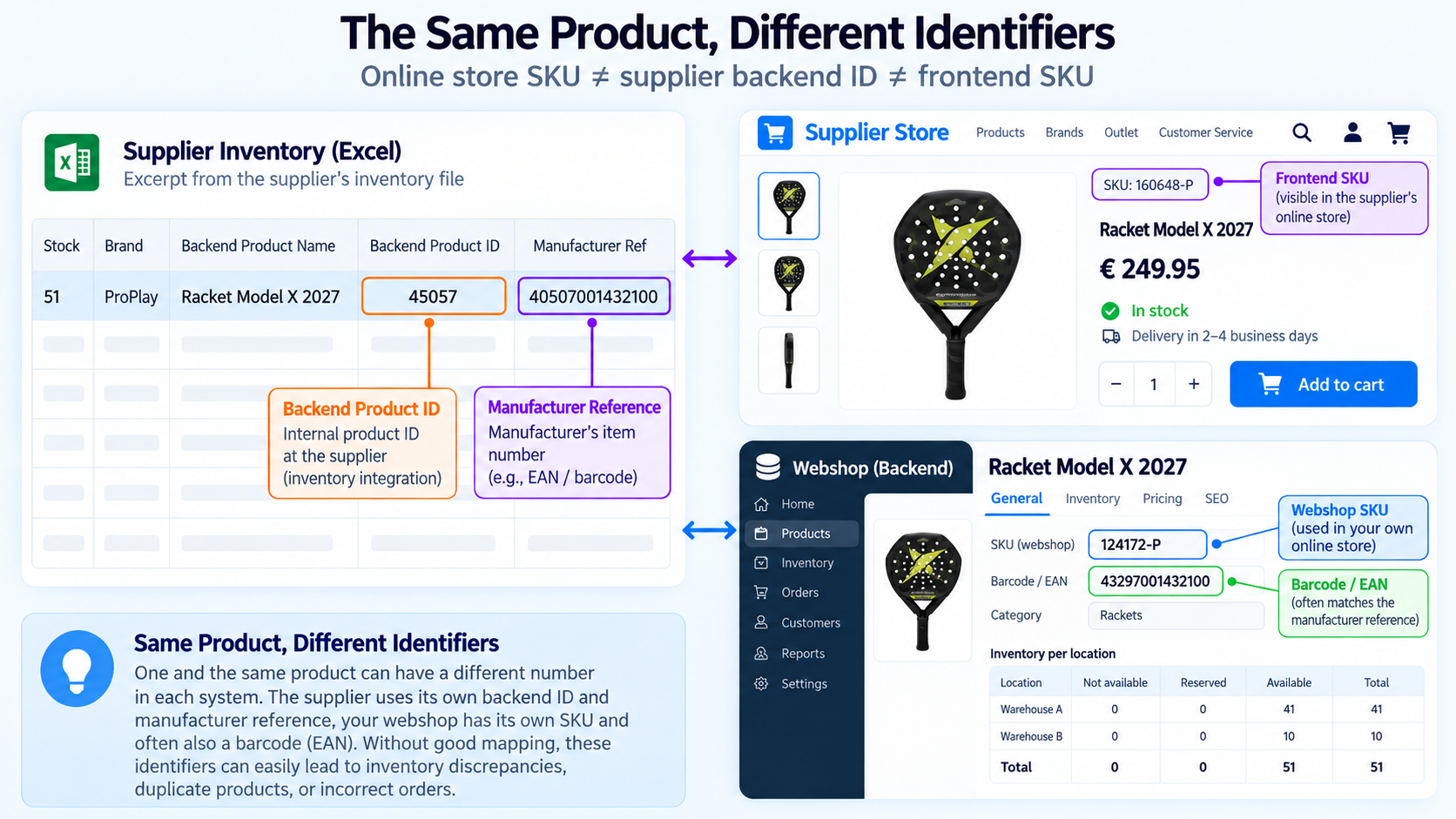
Such a mapping table is not an elegant long-term solution, but it may be necessary temporarily to regain control. Every correctly matched product then creates a fixed relationship between the retailer’s product record and the supplier’s item. From that point onward, inventory can once again be processed automatically, provided the supplier does not change its identifiers and new models are added according to the same structure. Human effort then shifts from manually checking inventory every day to managing exceptions and new records.
The risk arises when a temporary mapping is treated as though it has solved the underlying data problem. An incorrect match is then no longer made manually just once, but may be repeated during every subsequent synchronization. Automation does not only increase speed; it also increases the scale at which an error can spread. With an assortment of hundreds of models, a single incorrect relationship between two databases can be enough to keep publishing the wrong inventory status for a product.
Automation does not solve a data problem. If the source data is ambiguous, you mainly automate the distribution of errors.
An inventory process should therefore not only verify whether data is being imported, but also why a particular product has been linked to a particular supplier record. That distinction becomes increasingly important as assortments grow. A connection that can still be checked manually across fifty products may become an unnoticed structural source of errors across hundreds or thousands of variants. At that point, data hygiene is no longer a technical preference but a form of commercial risk management.
From Dirty Data to Commercial Risk
Individually, the different problems can appear relatively small. A missing SKU, a different product title, or a product that is unavailable in one channel does not necessarily constitute a major operational problem on its own. Complexity emerges because these discrepancies reinforce one another. A product with a different name, a missing EAN, and a different availability status can no longer be matched reliably without additional verification. Once the same data is also used for inventory, advertising, and product feeds, a single error can propagate across multiple commercial processes.
Technical discrepancies should therefore not be viewed merely as data problems, but translated directly into their commercial consequences. A missing field only becomes truly relevant when it is clear what happens if that field is interpreted incorrectly. The situations below appeared in different forms during the practical analysis and demonstrate why an inventory feed should never be judged solely on technical validity.
| Data Problem | Technical Consequence | Commercial Risk | Required Control |
|---|---|---|---|
| Missing SKU | No reliable automated match | Incorrect inventory status | Manual mapping or another unique key |
| Missing or inconsistent EAN | Product cannot be identified unambiguously | Wrong item or variant linked | Verification against the source |
| Different product name | Text matching becomes unreliable | Models or variants may be confused | Fixed master mapping |
| Available B2C, unavailable B2B | Public inventory does not provide a reliable B2B status | Order cannot be fulfilled through the purchasing channel | Make B2B availability authoritative |
| New collection not yet released B2B | Item is missing from regular purchasing data | Delayed product launch | Evaluate an additional dealer or launch route |
The final two situations are particularly interesting because they are not necessarily caused by poor technology. Two systems can both function correctly from a technical standpoint while still representing different commercial realities. A consumer website may show that a product is available, while the same item cannot be ordered through a retailer’s B2B account. To the customer, that looks like a single inventory position; to the retailer, they are two entirely different sales channels with different rights, prices, and conditions.
The B2B/B2C Paradox: Visible Is Not the Same as Available
That distinction became very tangible during the inventory review. Certain items were visible and available to order on the international supplier’s public consumer website, while they were unavailable in the B2B portal or did not appear there as regularly purchasable items. Anyone looking exclusively at the public website could therefore reasonably conclude that inventory existed. From the retailer’s perspective, however, that inventory effectively did not exist because the product was not available through the agreed B2B purchasing channel.
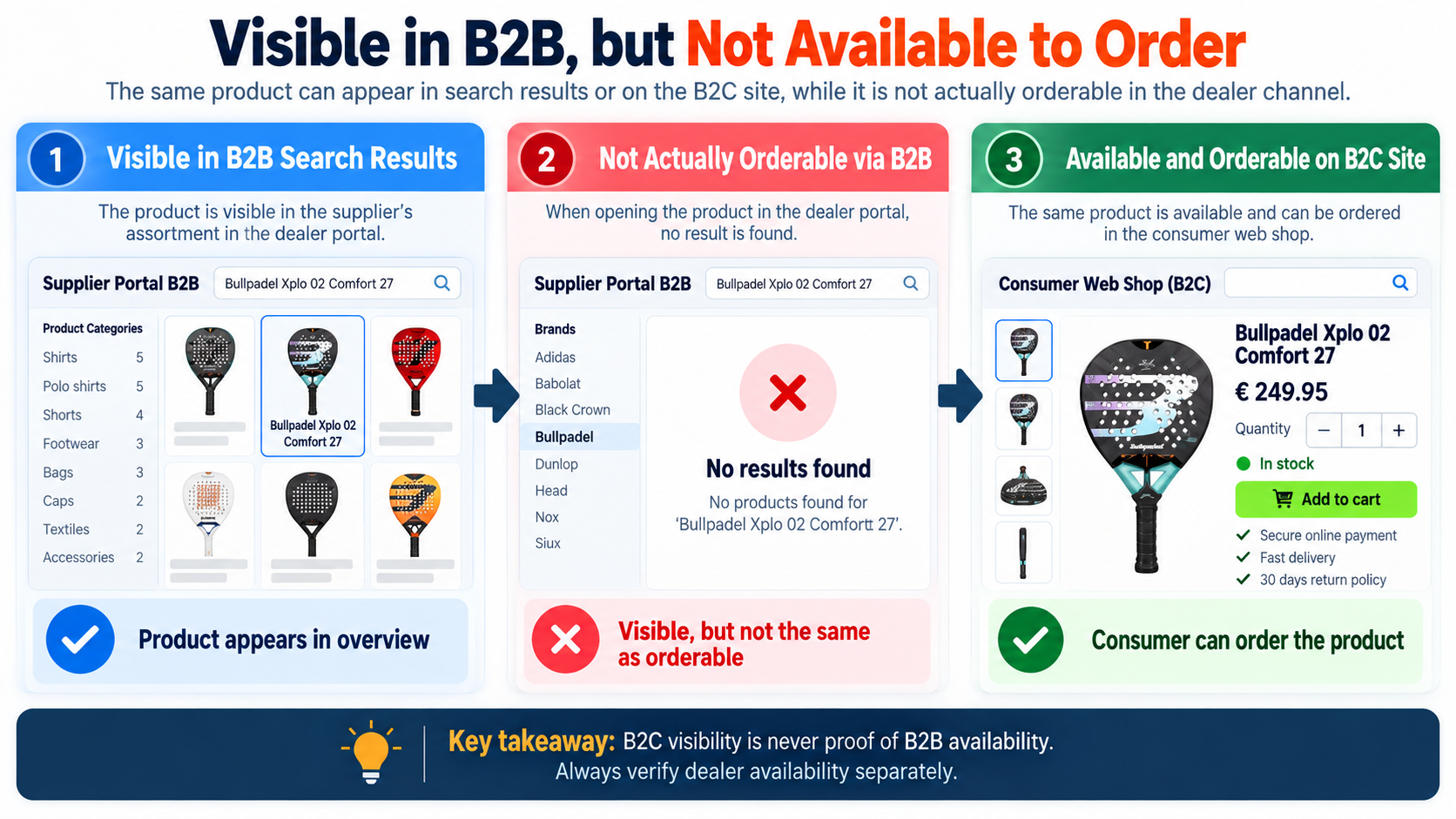
Why a supplier maintains different inventory positions or assortments across channels cannot be determined from that observation alone. Possible explanations include reserved inventory, separate distribution agreements, phased releases, different assortment windows, or a deliberate channel strategy. For the retailer, however, that unknown cause does not change the operational consequence. B2B availability must determine what can actually be offered to customers because only that inventory can be fulfilled through the agreed purchasing route.
This is also why scraping a consumer-facing site or automatically adopting a general public inventory status can be risky. The technology may function perfectly while still processing the wrong commercial signal. The system correctly reads that the product is available from the supplier, but does not understand that this availability applies only to consumers and not to the B2B account through which the retailer must purchase. The result is technically correct information being interpreted incorrectly from a commercial perspective.
In such a situation, deliberately setting inventory to zero is not a missed sales opportunity but a form of risk management. An online store that temporarily marks an item as unavailable can start selling it again once B2B inventory returns. A retailer that accepts an order it cannot subsequently fulfill must not only issue a refund but also explain why a product presented as available could not actually be delivered. At that point, a data problem moves directly into customer service and brand reputation.
A Product Can Be Technically Available and Commercially Unviable
B2C availability itself does not create a viable alternative purchasing route either. A retailer may technically be able to order a product through the consumer website, but that does not demonstrate that the transaction makes economic sense. The consumer price already includes the supplier’s retail margin and operating costs, usually leaving little room for a second retailer. If the retailer then needs to sell the same product at a competitive market price, its own costs still have to be funded from whatever margin remains.
The issue therefore extends beyond the simple difference between purchase price and selling price. VAT, shipping, payment processor fees, platform costs, marketing expenses, customer service, and return risk all determine whether a product can be sold responsibly. Particularly for products with relatively high return costs, a theoretically positive gross margin may still be insufficient to justify the commercial risk. Availability should therefore answer at least two questions: can the product actually be purchased, and can it then be resold on commercially viable terms?
A product is only truly available to a retailer when it is both deliverable and commercially viable to purchase.
That distinction is easy to miss when product data and marketing are managed separately from financial logic. A marketer sees a popular model and wants it to become discoverable as quickly as possible, a feed manager sees a URL that reports inventory, and the customer ultimately sees a Buy button. Only when someone looks at the entire chain does it become clear that selling the same product at the current market price may leave almost no room for the costs incurred between order and delivery. Technical availability is therefore not synonymous with commercial availability.
New Collections Reveal Where the Supply Chain Overtakes Marketing
The problem becomes even sharper with new product collections. During the same assortment analysis, models from a new collection were already visible on the supplier’s consumer website and at several competing retailers, while they were still unavailable or only selectively available through the regular B2B channel. That is not a classic inventory error. The B2B feed may correctly indicate that the retailer’s own account cannot yet purchase the item even while other market participants are already actively selling it.
For a specialized online retailer, that creates a strategic disadvantage that cannot be solved through faster synchronization. Competitors can have their product pages indexed earlier, activate advertising, collect reviews, and capture the first search demand for a new model. If the retailer’s own B2B channel releases the product later, the commercial launch simply does not begin at the same time. In that situation, the supply chain literally determines when marketing can begin.
[IMAGE 4 – anonymized screenshot of a new collection or model range that is already visible in a consumer or market context while regular B2B purchasing availability is still missing or restricted. Remove company and supplier identification; keep the launch gap itself visible.]
That does not mean an existing primary supplier is therefore unsuitable. For established models, the same supplier may offer attractive B2B pricing, broad availability, and operational convenience. It does, however, create a reason to treat product launches as a separate purchasing category. The best supplier for a mature assortment is not automatically the best route during the first weeks of a new collection.
For new product launches, a retailer should therefore assess separately:
- when the actual B2B dealer release begins;
- which new models are commercially important enough to carry early;
- whether an additional distributor or direct dealer relationship is required for launches;
- when regular B2B purchasing becomes more attractive than early availability.
A small or midsize specialized retailer does not have to stock every new collection in full to achieve this. It may be sufficient to select a limited number of models with demonstrable demand at launch, while adding the remainder later through the regular B2B channel. This avoids unnecessary complexity in the supplier structure while preventing one distribution channel from automatically determining the market launch timing of the entire assortment.
The Product Feed Is Not the Beginning of the Chain
Many discussions about e-commerce integration begin with the question of how a product feed should be configured. That is understandable because the feed is the visible technical connection between systems. Commercially, however, the process begins much earlier. Before an item can safely be distributed through a feed, its product identity, source data, B2B availability, purchase price, and margin must already have been established with sufficient reliability.
A technically perfect feed cannot reconstruct a missing item number that the supplier itself does not publish consistently. Nor can it determine that B2C inventory is unavailable to a particular B2B account unless that logic is explicitly recorded in the data or an intermediate layer. An inventory feed also cannot independently determine whether a product with a certain purchase price still generates sufficient margin after VAT, shipping, and return risk have been included. Those decisions come before the distribution of the data.
The quality of an e-commerce integration therefore depends on more than APIs, CSV files, or synchronization frequency. Just as important is the quality of the data model used to manage exceptions. Which source is authoritative when two systems contradict one another? Which products must never be activated automatically without B2B inventory? Which new models require a margin check first, and how do you prevent a manually corrected exception from being overwritten during the next import?
Only once those questions have been answered does automation deliver its real value. It can then take over repetitive work reliably instead of spreading uncertainty through the chain faster. That distinction is fundamental for any online retailer that depends on external suppliers and manages hundreds of products. Scalability does not come from automating as much as possible, but from knowing which data is reliable enough to automate without human intervention.
Marketing Expertise Does Not Stop at the Front End of the Online Store
This practical case also exposes a broader limitation in the way digital marketing is often defined. The discipline is easily reduced to campaign platforms, content, dashboards, and conversion optimization. Those are visible areas in which results can be reported relatively easily, but in e-commerce they represent only part of the commercial system. A campaign that generates revenue for a product that later proves unavailable may look successful inside the advertising interface while failing the business as a whole.
That does not mean every marketer needs to program APIs, clean inventory files, or manage international purchasing contracts. It does mean that anyone responsible for e-commerce should understand how those elements constrain marketing performance. A rising conversion rate says little if more orders simultaneously have to be canceled. A product feed with technically valid fields is likewise unreliable if the underlying inventory source is being interpreted incorrectly from a commercial perspective.
This is where the difference emerges between operating marketing tools and understanding the system in which those tools function. One person does not need to perform every technical task, but someone must be able to recognize when a problem originates outside the advertising interface and which discipline is needed to solve it. Sometimes the cause lies in product data, sometimes in inventory segmentation, sometimes in margin, and sometimes in the structure of the supplier relationship. Anyone who looks only at the front end will not see the symptoms until the customer encounters them.
For organizations seeking to scale e-commerce, that is not a theoretical distinction. As assortments, countries, suppliers, and sales channels grow, the number of dependencies increases faster than the number of visible pages in the online store. A manual exception that remains manageable across one hundred products can become a structural source of errors across one thousand. Scalability therefore begins not only with more traffic or more automation, but with a data model and supply chain capable of handling the additional commercial pressure.
The Customer Ultimately Experiences Every Failure in the Chain
The customer does not need to know anything about SKUs, EANs, mapping tables, B2B portals, or inventory feeds. Nor is that the customer’s responsibility. They see a product, receive a promise of availability, and expect the order to be fulfilled. That is precisely why the complexity behind the scenes must be resolved before the Buy button, not afterward.
For marketers and e-commerce professionals, that may be the most important lesson from this practical case. Data quality is not merely an internal technical issue when poor data determines which products are advertised, sold, or canceled. Supplier strategy is not purely a purchasing issue when the chosen distribution route determines whether a new collection can reach the market weeks earlier or later. And inventory management is not a back-office activity when an incorrect status directly affects customer trust, acquisition costs, and margin.
The front end of e-commerce determines how convincingly a product is presented and sold. The back end determines whether that commercial promise can actually be fulfilled. Anyone who optimizes only advertising, content, and conversion without considering the quality of product data, inventory, and purchasing terms is ultimately optimizing only part of the system. In fact, the better marketing performs, the faster a weak supply chain becomes visible when additional demand cannot be fulfilled reliably.
The most mature form of e-commerce marketing therefore does not begin with the question of how much additional traffic a campaign can generate, but with a more fundamental check: can the organization fulfill the demand it creates reliably, profitably, and without unnecessary friction? Only when product data, B2B availability, margin, and fulfillment align does front-end marketing deliver the value that dashboards attribute to it.


