
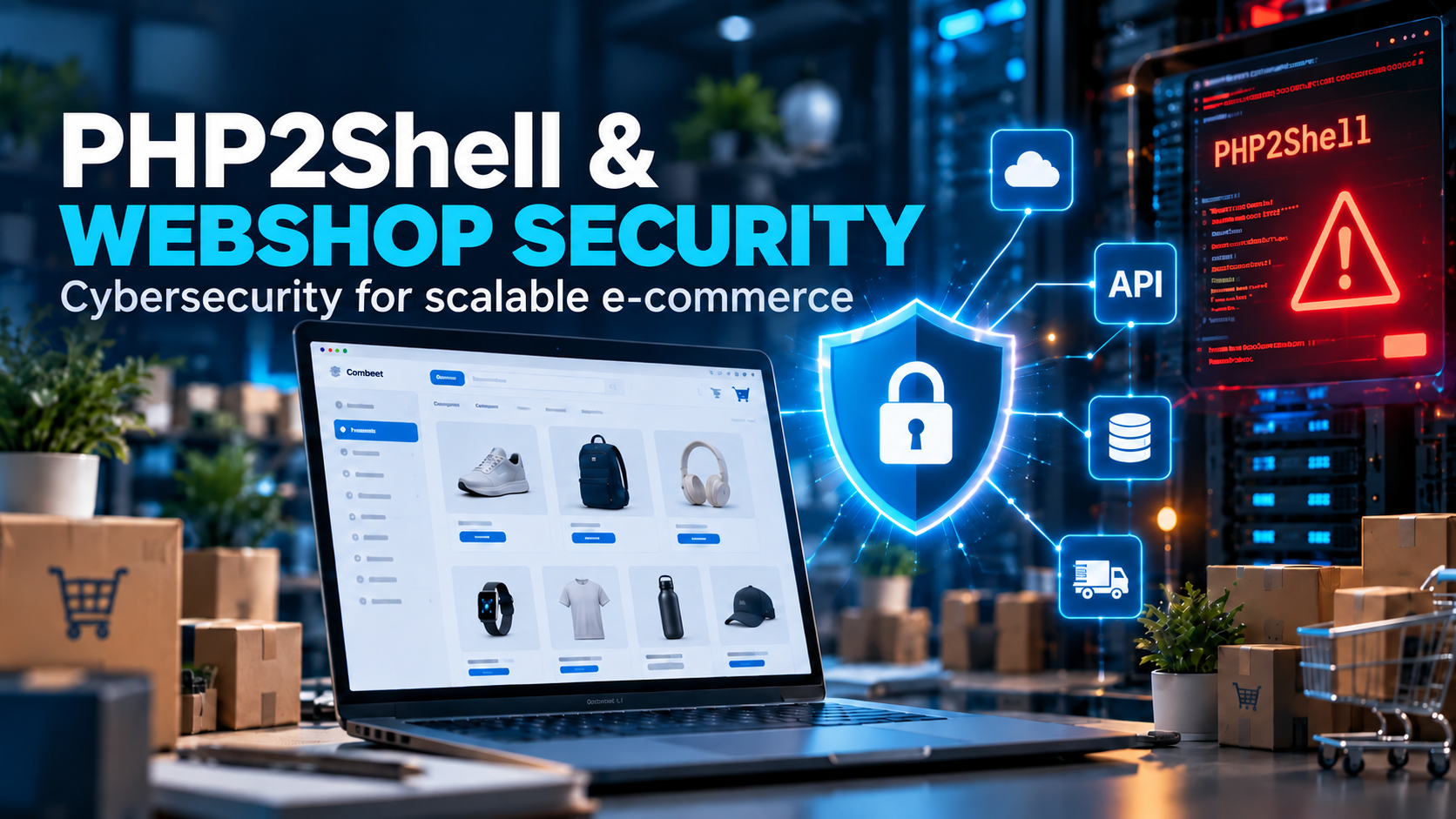
PHP2Shell and the Vulnerable Online Store: Why Automation Without Cybersecurity Cannot Scale
An online store can operate efficiently, optimize advertising automatically, and publish thousands of products without manual intervention. Yet one security vulnerability can disrupt the entire commercial operation. The emergency PHP releases of October 21, 2026, and the attacks involving UpdraftCentral days earlier demonstrate how exposed interconnected digital systems can become. For dropshipping businesses that depend on outside vendors, platforms, and automated workflows, this is not an abstract IT problem. It is a strategic business risk with immediate financial consequences.
In e-commerce, scalability is often defined by more product feeds, faster APIs, and fewer manual tasks. The hidden assumption is that an automated process is also a dependable one. That is only true when access controls, software maintenance, data integrity, and recovery processes are designed with the same discipline as pricing and fulfillment. Otherwise, automation expands not only revenue capacity but also the reach of a potential attack.
October 2026: Two Warnings, Two Different Attack Paths
On October 21, the PHP project released emergency security updates for CVE-2026-109618 and CVE-2026-109619. Both flaws received a critical CVSS 4.0 score of 9.2 and can, under vulnerable conditions, allow attackers to execute code on a server without first authenticating. The defects are in the PHP runtime itself, below the application code used by countless websites and commerce systems. According to the official PHP security advisory, fixed releases include PHP 8.5.12, 8.4.27, 8.3.36, and 8.2.35.
This is not a weakness limited to WordPress, WooCommerce, or Magento. Other PHP applications can be exposed when they serve web requests through a vulnerable runtime. PHP identifies configurations including PHP-FPM, Apache with mod_php, php-cgi, FrankenPHP, and LiteSpeed as potentially affected. Guidance from the Netherlands National Cyber Security Center reinforces a critical distinction: an up-to-date content management system does not prove that the server underneath it has been secured.
Days earlier, a separate campaign exposed a different type of dependency. On October 18 and 19, attackers used compromised UpdraftCentral connection keys to issue apparently legitimate remote-management commands and install unauthorized plugins on connected WordPress sites. TeamUpdraft confirmed unauthorized access to its environment and said its customer database, including remote connection keys, may have been accessed. That does not mean every UpdraftPlus installation was compromised. Exposure depended in part on whether a relevant management connection existed.
PHP2Shell and the UpdraftCentral campaign therefore illustrate two distinct problems. One concerns vulnerabilities in software running beneath a website; the other concerns the misuse of credentials trusted by a website. In the first case, the PHP runtime must be properly patched, even if the storefront looks normal. In the second, operators must determine what commands were executed and whether unauthorized plugins, accounts, or other changes remain. Calling both events merely ‘WordPress hacks’ would hide the underlying causes and lead to poor decisions.
Digital Business Models Have Very Real Dependencies
A professional dropshipping operation is rarely a single, self-contained application. Its storefront depends on suppliers, inventory feeds, pricing engines, payment services, shipping providers, advertising channels, and customer communications. Each order passes through multiple systems that exchange instructions automatically. Much of the model’s commercial appeal comes from replacing manual coordination with those integrated workflows.
However, attackers do not need to compromise every component to cause meaningful disruption. Unreliable product data can push incorrect prices or inventory levels into the store. An interrupted order integration can leave a customer charged while the supplier never receives the order. Misused administrative permissions can also produce changes that resemble authorized maintenance or normal business operations.
That makes cybersecurity directly relevant to profitability. A system built to distribute legitimate transactions efficiently may distribute incorrect instructions just as quickly. In my earlier examination of API-first dropshipping, I addressed the operational value of structured and dependable data flows. The October attacks add another requirement: an integration must not only transfer information correctly, but also receive no more authority than its purpose requires.
Automation makes an e-commerce operation scalable. Without controlled access and recovery, it also makes the operation scalable in its vulnerability.
Why a Cyberattack Creates Commercial Damage Beyond Downtime
The direct cost of an attack is often reduced to emergency IT support, website restoration, or a few hours of downtime. That accounting is incomplete. After a technical fix, a retailer may still be working through payment exceptions, stale inventory, failed fulfillment messages, and discrepancies between systems. Advertising may continue sending paid traffic into an environment that cannot reliably process a sale.
Dropshipping creates an additional business challenge because responsibility is distributed across companies while the customer experience is not. The customer pays the retailer, even when a separate supplier fulfills the order. If an integration breaks, customers rarely care which technical party caused the failure. They hold the selling business responsible for the promise made at checkout.
Reputational damage can also outlast the outage. A buyer who receives a cancellation, waits for a refund, or worries about personal data does not assess the merits of the store’s systems architecture. They assess whether the merchant is trustworthy. For management purposes, recovery costs should therefore be considered alongside missed contribution margin, wasted advertising, customer service work, potential refunds, and customer retention risks.
What PHP2Shell Really Tells Us About Platform Choices
After a critical PHP vulnerability, moving everything to headless commerce or a software-as-a-service platform may sound like the obvious answer. It is not that simple. WooCommerce and Adobe Commerce generally require clear ownership of their hosting environments, application components, and patching responsibilities. With a managed platform such as Shopify, the provider handles more of the underlying infrastructure. That can substantially reduce a merchant’s operational workload without removing every security exposure.
Headless architecture separates the customer-facing presentation from backend services and can support more deliberate segmentation and access control. Those benefits matter when they are actually implemented. A vulnerable PHP service behind a sophisticated frontend, however, remains vulnerable. Publicly exposed APIs, poorly secured credentials, and excessive privileges can also turn a modular design into a larger collection of attack opportunities.
Managed SaaS stores have their own dependencies: staff accounts, third-party apps, API tokens, and outside service providers. A compromised app or key may affect orders, products, or customer information even when the infrastructure provider maintains its own servers correctly. The strategic distinction is not PHP versus headless, or WooCommerce versus Shopify. It is who owns each security responsibility, what third parties are authorized to do, and how quickly access can be revoked when something goes wrong.
| Architecture | Primary merchant responsibility | Key security priority |
|---|---|---|
| Self-managed PHP store | Runtime, hosting, CMS, extensions, and access | Patch management and compromise investigation |
| Headless or API-first commerce | Backend, APIs, integration keys, and permissions | Segmentation and least-privilege access |
| Managed SaaS store | Accounts, apps, integrations, and third-party access | Vendor dependence and token misuse |
No row in this comparison describes an inherently safe or unsafe platform. What changes is the division of labor and the expertise the merchant must supply. For a small specialized online store, managed infrastructure may be commercially sensible. An enterprise retailer with intricate systems may need more architectural control. The right choice follows from actual risk, operational capacity, and recovery needs rather than whichever technology label is currently fashionable.
The Overlooked Risk: Trusted External Administrators
The UpdraftCentral campaign offers a particularly important lesson for multi-store operators. Centralized management services are deliberately granted permissions to update, maintain, and sometimes install software across several websites. That saves time for agencies and entrepreneurs overseeing multiple properties. But the same permissions often extend far beyond viewing a status report or creating a routine backup.
A stolen connection key can make an unauthorized instruction look legitimate because a system recognizes the cryptographic signature. A control that simply checks whether a command is correctly signed will not necessarily recognize that the authorized key holder has changed. Operators therefore need clear inventories of credentials, limited permissions, rapid revocation processes, and independent monitoring. An old management connection left active for convenience can otherwise become a largely invisible liability.
On October 19, TeamUpdraft issued releases that invalidated older UpdraftCentral connections and advised customers to look for unfamiliar plugins, accounts, and changes. Installing a vendor update may close an access route, but it does not prove that a previously compromised site is clean. Operators may also need to rotate credentials and verify system integrity before reconnecting services. That distinction between closing a vulnerability and restoring trust is frequently missed in commercial discussions.
From Security Controls to Measurable Business Continuity
An e-commerce founder does not need to write PHP code to take responsibility for business continuity. The founder does need to know who manages the runtime, who applies updates, which external services possess privileged credentials, and who makes decisions during an attack. Critical integrations should have documented methods for being disabled or isolated without unnecessarily interrupting everything else. This is especially important when marketing, fulfillment, finance, and customer support depend on the same automated processes.
A practical security program begins with an inventory of platforms and permissions, not by adding another plugin. Once the dependencies are understood, organizations can define responsibilities and test recovery procedures. Restoring a website backup is only one part of recovery. The business must also confirm that orders, payment statuses, inventory, and supplier acknowledgments can be trusted again.
Four controls deserve immediate attention in automated commerce operations:
- Assign clear owners for hosting, PHP, platform, application, and integration updates.
- Restrict administrator accounts and API keys to necessary privileges, and revoke unused access.
- Review logs, account changes, installed software, and unusual order activity for signs of misuse.
- Test recovery across checkout, payments, inventory, fulfillment, and supplier communication.
Sequence matters. If a company cannot identify which integrations are business-critical, it cannot efficiently assess the impact of an attack. Without a designated owner, urgent security notices can disappear between agencies, hosting providers, and technology vendors. Without tested recovery steps, every repair becomes a production experiment during the most expensive possible moment.
A Vulnerability Does Not Automatically Mean a Personal Data Breach
Legal consequences require similar precision. A vulnerable PHP server does not, by itself, establish that customer data was stolen. Nor does every unauthorized access attempt trigger an obligation to contact every customer. The first question is whether the confidentiality, integrity, or availability of personal data was actually affected. Only then can the organization evaluate the consequences for individuals and the applicable notification duties.
Under the EU General Data Protection Regulation, a reportable personal data breach must generally be notified to the competent supervisory authority within 72 hours of the controller becoming aware of it. Not every breach requires notification; the assessment depends on the risk to people’s rights and freedoms. A high risk can also trigger a duty to inform the affected individuals. The Dutch Data Protection Authority explains the conditions and reporting timelines in detail.
Using an outside hosting company or SaaS vendor does not automatically transfer a merchant’s privacy responsibilities to that vendor. Contractual roles determine some of the obligations, but controllers remain accountable for evaluating their own legal duties. Escalation contacts, vendor notification commitments, and investigation procedures should therefore be defined before something happens. Waiting for a service provider to finish every technical detail may be incompatible with a running reporting deadline.
The Real Performance Metric Is Controlled Recovery, Not Just Uptime
Many retailers measure technical reliability primarily through website uptime. A site can be reachable, however, while displaying incorrect prices, accepting orders it cannot forward, or publishing inventory values that were manipulated elsewhere. Compromised systems can also leave unnoticed discrepancies after the visible attack has been contained. Uptime alone cannot establish whether an e-commerce business is operating safely or fulfilling customer commitments accurately.
More useful management reporting combines availability with commercial integrity. Time to detection, time to revoke compromised access, recovery time for order processing, and the volume of transactions requiring reconciliation are meaningful measures. In my earlier article on inventory synchronization through APIs, I examined how system discrepancies erode margins. Cybersecurity introduces the possibility that the same discrepancies may result from deliberately unauthorized instructions rather than accidental synchronization errors.
Recovery should therefore not end with a message announcing that the website is back online. Unauthorized changes must first be removed and affected credentials replaced. Then orders, payment records, inventory, and supplier confirmations need to be reconciled against dependable sources. The commercial operation is recovered only when its underlying facts are trustworthy again.
An online store is not fully recovered when the website loads. It is recovered when its data, payments, and delivery promises can once again be verified.
What Merchants Should Check Following the PHP2Shell Alert
For businesses operating PHP websites or stores, the October 2026 alert calls for concrete action. Ask the hosting provider or technical team to identify the PHP runtime serving actual requests, including separate applications, APIs, and background services. Verify that the relevant security patch has been installed; Linux distributors sometimes backport fixes without changing the version string in the same way as an upstream PHP release. A version number shown inside a CMS dashboard should not be the sole evidence that the server is protected.
The upstream fixed PHP releases are 8.2.35, 8.3.36, 8.4.27, and 8.5.12, or an appropriately patched package from a supported distribution or vendor. PHP 8.1 and older no longer receive regular upstream security fixes, which makes a documented support arrangement or migration particularly important. According to the PHP project, installing the relevant patch is the only complete remedy for these vulnerabilities. Firewalls and temporary restrictions can support risk reduction but are not equivalent replacements.
Organizations that use or previously used UpdraftCentral should separately review connection keys, unexpected plugins, and unauthorized accounts. They should follow the latest TeamUpdraft guidance as the vendor’s investigation continues. An unused connection that remains active can be just as important as an actively maintained one. The relevant risk is not merely which applications are installed but which permissions still exist.
Cybersecurity Is a Prerequisite for Scalable Commerce
The appeal of automated dropshipping remains real. A business can operate a specialized assortment, reach international buyers, and coordinate suppliers without financing a substantial inventory position. But lower inventory exposure does not mean the business operates without risk. Some of that exposure shifts into software, data flows, vendors, customer trust, and platform access. When these systems are disrupted, the consequences can spread across every sales channel at once.
The lessons of October 2026 therefore extend well beyond installing a PHP patch. They concern how a company designs its dependencies, delegates authority, and prepares to recover. Mature architecture combines automation with boundaries: no integration receives unlimited access, no credential remains valid indefinitely without review, and no single outside service should be able to compromise an entire operation unnecessarily. That work may attract less attention than a new AI engine or dynamic pricing model, but it determines whether growth remains manageable.
For OnlineMarketingMan, the strategic conclusion is clear. The next phase of e-commerce will not necessarily be won by the operator who automates the largest number of tasks. It will favor businesses that understand, control, and recover the dependencies created by that automation. A truly scalable online store must handle large volumes without constant manual intervention, but it must also be able to stop safely, restore trustworthy data, and resume commerce when technology or a trusted partner fails.
Related Articles on Supply Chains, AI Shopping Agents, and Pricing Transparency:
WHY AN UNRELIABLE SUPPLY CHAIN
CAN UNDERMINE EVEN SUCCESSFUL
E-COMMERCE MARKETING
Even the best campaign cannot deliver lasting value when product data, supplier arrangements, and inventory availability are unreliable. This article examines how operational dependencies affect canceled orders, advertising costs, customer confidence, and the commercial performance of an online store.
HOW AI SHOPPING AGENTS CHANGE
THE WAY CONSUMERS FIND, COMPARE,
AND BUY PRODUCTS FROM ONLINE STORES

AI shopping agents compare offers, assess product information, and increasingly support the buying process. Learn why accurate data, consistent integrations, and oversight of automated processes matter as software joins consumers in evaluating and selecting products from online stores.
WHY OPAQUE DYNAMIC PRICING ALGORITHMS UNDERMINE CONSUMER
TRUST IN ONLINE STORES

Dynamic prices may support revenue and margin optimization, but unexplained price differences and poorly governed algorithms can damage customer confidence. This analysis considers the balance between automated pricing, transparent communication, and accountable commercial decision-making.
OnlineMarketingMan
Build. Automate. Expand.